Braces Tightening Appointments: What to Expect With Elastics
Posted on
What Happens at a Braces Tightening Appointment: My Honest Experience (Including Elastics)
If you're about to have your first braces tightening appointment, or you've just been told you need elastics added and have no idea what that means - this is for you. I wore train track metal braces for over two years in my thirties, so I've sat in that orthodontist's chair more times than I can count. Here's what actually happens, what to expect with elastics, and the honest bits nobody really tells you.
What actually happens at a braces tightening appointment
The first thing that surprised me was how quick it all is. My appointments were booked for 15 minutes, and I was often in and out faster than that. Once I was a regular, the receptionist would just wave me straight through. There's no drama, no pain in the chair - it's mostly just the orthodontist checking your progress, changing the wire if needed, adding or swapping out elastics, and sending you on your way.
At each appointment my orthodontist would measure gaps, check alignment, and tell me what had changed since last time. Sometimes there was visible progress. Sometimes there wasn't, which is honestly the most demoralising part - sitting in that chair being told nothing has moved in two appointments, even though you've been eating carefully and cleaning around all those brackets for six weeks.
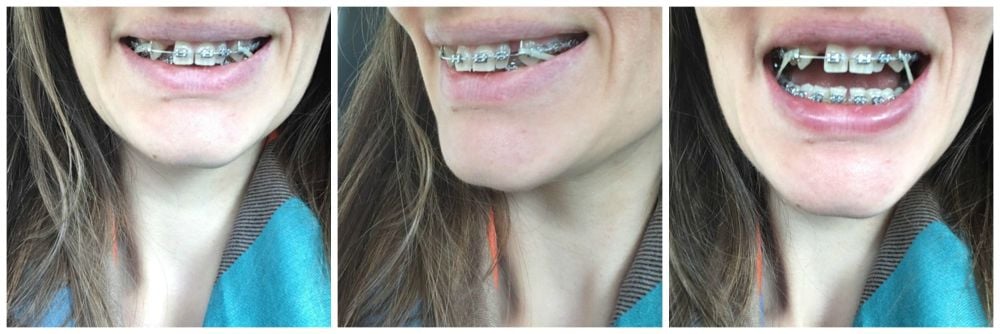
Looking happy, but argggg, pesky elastics added at a braces tightening appointment.
Does a braces tightening hurt?
Not in the appointment itself. The soreness comes in the hours and days after, once your teeth have had time to register what's happened to them. For me it was usually a dull ache rather than sharp pain, and it would ease off after a couple of days. The worst I experienced was after elastics were added to just my two front bottom teeth - more on that below.
The different types of elastics and what they do
Elastics were a big part of my braces journey, and there are a few different kinds. They all do slightly different jobs.
The first elastics I had were small loops wrapped around the brackets on my teeth, pulling certain teeth back or forward into position. These are the ones you might spot as a faint row along the brace. Mine were clear, which was great until I ate a vegetable curry and they turned bright neon yellow overnight. So if you're having elastics fitted - avoid curry, or accept the neon look.
These loop elastics worked fast. One day after they were first fitted I could already see my canine had shifted around 1mm. A week later it was closer to 2mm. That visible progress after months of not being able to see much change at all felt amazing.
Later I had a long single elastic stretched across all of my top brace at once to bring everything together and close a 2mm gap. And at various points I had small clusters of elastics targeting specific teeth - five elastics on my peg tooth and the teeth behind it, for example, to pull it into the right position for a veneer.
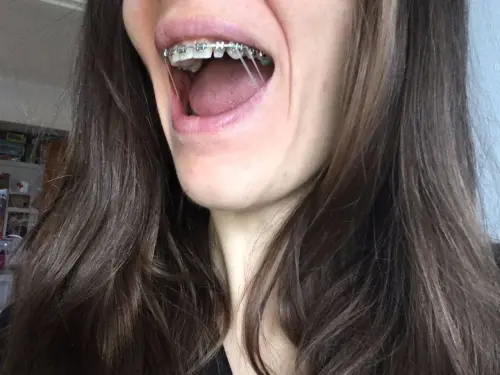
Photo of braces elastics from top to bottom.
Top-to-bottom elastics: the ones I really struggled with
The top-to-bottom elastics were a different experience altogether, and the main focus of this particular appointment. My orthodontist added little hooks to the front of my top brace, and I had to hook elastics from these down to hooks on my bottom brace, crossing my mouth.
The purpose was to correct my overbite, which was sitting at 5.5mm when it should be around 2mm. Unlike the wire tightenings, which cause pressure for a day or two then ease off, these elastics kept constant pressure all day because I was changing them fresh every single day. You can feel them working the whole time. It's not painful exactly - more like a persistent squeeze across your mouth and jaw.
The biggest challenge was actually remembering to wear them. You have to take them out every time you eat and every time you brush your teeth, so you're removing them five to seven times a day. I would take them out for lunch, get distracted with work or the kids, and by the time I remembered it was almost dinner time again. Then I'd forget after that too.
I tried wearing them only at night to make up for it. After some Googling I found out it doesn't work that way - it's the continuous gentle force that moves teeth, not a stronger force for fewer hours. So part-time wear is basically wasted effort.
I'll be honest: the top-to-bottom elastics were my least favourite part of the whole braces experience. They gave me a low-level headache that disappeared the moment I took them out. At one point my overbite actually got worse despite wearing them, going up to 6mm, which felt gutting after all the effort. They did eventually work though - by my 14th tightening my overbite had reduced to around 4mm. So they were doing something, just slowly.
What happened with my bottom teeth elastics
Around the same appointment I also had elastics added to my bottom front teeth to close a gap there. My orthodontist had first tried putting elastics across six bottom teeth to move them all together - which didn't work at all after three appointments. So she changed approach and put elastics on just the front two teeth instead.
The difference was immediate and quite dramatic. The gap literally halved in size within 24 hours!
My front bottom teeth were so sensitive for about three days afterwards that I could really feel them. That was probably the most uncomfortable single moment in the whole braces process for me - not unbearable, but genuinely noticeable. Worth it though, as the gap closed.
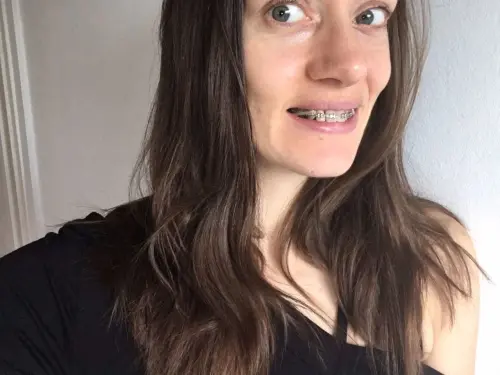
After my 13th tightening appointment at 20 months with my adult brace in my 30s.
How long does a tightening appointment take
As I mentioned, mine were booked for 15 minutes. Most of the time I was done quicker than that. When elastics were being changed or added it might take slightly longer, but we're still talking a short appointment. The time-consuming part is the waiting in between appointments - six to ten weeks, over and over, for two-plus years. The appointment itself is the easy bit.
My full braces journey
If you want to read about the whole experience from consultation to retainer, I've also written about my adult braces story over on Healthy Vix, including what getting braces at 30 was really like. It covers the emotional side of the process as much as the practical, which I think is the bit that's hardest to find when you're researching.
Tightening appointments sound scarier than they are. The elastics are more of an ongoing daily commitment than any single appointment is a challenge. If you're heading into this process, just know that the forgetting-to-put-them-back-in thing happens to everyone - and the curry staining is a genuine hazard nobody warns you about.