Tax Tips for Bloggers and Self-Employed Content Creators
Posted on
Tax doesn't have to be terrifying, but it does need to be taken seriously. I've been self-employed since 2012 and have filed my own self-assessment every year since then.
Here are the tax tips I wish I'd known earlier as a blogger - updated for the 2025/26 tax year, with a note on Making Tax Digital coming up at the end, which will affect a significant chunk of self-employed bloggers and content creators over the next few years.
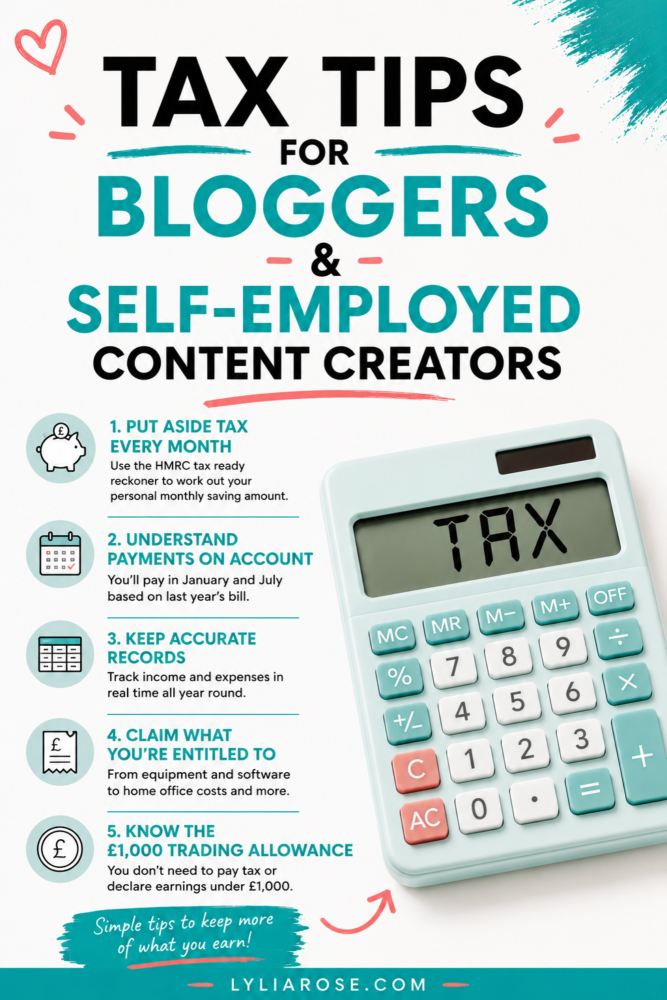
1. Put aside tax every single month
This is the most important tip on this list, and it's the one people most often skip because the temptation to spend the money is real.
The moment money comes in, transfer a portion straight into a separate savings account set aside for tax. Do not touch it. Treat it as money that was never yours to spend.
How much to set aside depends entirely on your income level. The effective rate (the real percentage of your total income that goes to tax and NI combined) varies significantly. At around £24,000 profit, you might only need to save around 13% of your income. At around £77,000, you're looking at closer to 27%.
The best way to work out your own figure accurately is to use the HMRC self-employed tax ready reckoner with your estimated annual profit, then divide the result by 12 to get your monthly saving figure. Do this at the start of each tax year and adjust if your income changes significantly. Or, do it monthly with your exact monthly amount.
And if your income fluctuates month to month as a blogger, it's worth having a solid system for budgeting monthly with irregular income so you always know roughly what to set aside for tax.
The reason this matters so much is that HMRC doesn't take tax at source when you're self-employed - your tax bill arrives in one lump sum (or two if you're making payments on account), and if you haven't been saving throughout the year, that bill can be genuinely shocking.
2. Know how payment on account works before it catches you out
Payment on account is the thing that surprises self-employed people most often, and I've seen it cause real financial stress for bloggers who weren't prepared for it. If you're new to self-employment, it's worth reading up on financial security considerations before going self-employed to understand what's coming.
Here's how it works. Once your tax bill exceeds £1,000 for the first time, HMRC assumes your income will be similar next year and asks you to make advance payments towards your next tax bill. These payments (two of them, in January and July) are each 50% of your previous year's bill, on top of the bill you're already paying. So in that first year where your bill goes above £1,000, you'll be paying 150% of it in January - your current year's bill plus your first payment on account for next year.
If your income stays roughly the same year on year, it balances out, but if nobody warned you about it, it feels like a gut punch. Now you know.
3. Keep spreadsheet records of everything - updated in real time
I've used spreadsheets to manage my accounts ever since I started self-employment. I originally used Excel but switched to Google Sheets a few years ago. The big advantage for me is that everything syncs automatically across my two laptops and my phone. I can update a record on my phone the moment I make a purchase, and it's there when I sit down at my desk. My husband and I both use it for our respective business accounts, and having that visibility in real time makes the end of tax year far less stressful.
Record your income and expenses as they happen rather than trying to reconstruct them at the end of the year. Keep notes on what each expense was for, since HMRC expects expenses to be "wholly and exclusively" for business purposes and you need to be able to justify them.
Whatever system works for you - Google Sheets, a dedicated app, accounting software - use it consistently and update it often. The key is not leaving it until January.
4. Know what expenses you can claim
As a blogger or content creator, there's a reasonable range of expenses you can legitimately claim against your tax bill. These include:
- Equipment such as a camera, laptop, ring light, microphone, or desk
- Software subscriptions used for work (editing tools, scheduling apps, SEO tools, website software)
- Your website hosting and domain costs
- A proportion of your home broadband bill
- Office supplies and stationery
- Professional development such as courses or books relevant to your work
- A dedicated phone used for work, or the business proportion of your personal phone bill
- Marketing costs
- Accountant or bookkeeper fees if applicable
If you work from home, you can claim a proportion of household costs or use HMRC's simplified expenses flat rate, which is designed to make it easier to calculate without having to work out the exact percentage of your household bills. The flat rate is based on hours worked at home per month - £10 for 25-50 hours, £18 for 51-100 hours, and £26 for 101+ hours. These rates have been frozen since 2012 and have never been updated despite years of rising household costs and energy bills, which is frankly frustrating. Still, for lower earners or those just starting out, using the flat rate is simpler than calculating the actual proportion.
You can read more about the gov.uk simplified expenses for working from home to see whether this works for your situation. For many bloggers working full time from home, calculating actual costs may genuinely give a better result than the frozen flat rates.
5. Understand the £1,000 trading allowance
If you earn under £1,000 a year from self-employment, you don't need to pay tax on it or even declare it. This is the trading allowance, and it's useful to know about if you're just starting out.
Once you're earning above £1,000, you need to register for self-assessment and declare it. If you're not sure whether your blog income counts as taxable, it's worth reading when a side hustle becomes taxable in the UK for clarity on where HMRC draws the line.
It's worth noting here the £1000 allowance is based on turnover, not profit.
6. National Insurance - what's changed
If you've been self-employed for a while, you may remember paying both Class 2 and Class 4 National Insurance. Class 2 was abolished as a mandatory payment from April 2024. If your profits are above the Small Profits Threshold (£6,845 for 2025/26), you're automatically treated as having paid Class 2 and continue to build your State Pension entitlement without any additional payment. If your profits are below that, you can make voluntary Class 2 payments at £3.50 per week to protect your NI record.
Class 4 NIC is still paid on profits: 6% on profits between £12,570 and £50,270, and 2% on anything above that. This is a significant reduction from the 9% rate that applied before April 2024. While the government presented this as a saving, with frozen personal allowances, frozen simplified expenses and the rising cost of running a business, many self-employed people haven't felt meaningfully better off overall. But the simplification of having one NI payment rather than two is at least genuinely easier to manage.
7. Get proper advice if you need it
There's a lot you can do yourself with self-assessment, but if your income is growing significantly, you have multiple income streams, or you're unsure about any aspect of your tax position, it's worth getting professional input. Finding tax experts online who understand the self-employed and digital creator space can save you more than their fee in correctly claimed expenses or avoided penalties.
HMRC's own guidance is also genuinely useful and free - the gov.uk pages on self-employment and self-assessment are well-written and updated regularly.
Making Tax Digital: what bloggers need to know
This is the big one coming up, and if your income has been growing, you need to be aware of it now.
Making Tax Digital for Income Tax (MTD ITSA) is being rolled out in phases and will eventually affect most self-employed people. Instead of filing one annual self-assessment return, you'll be required to submit quarterly updates to HMRC using approved software, plus an end-of-year declaration.
The phase-in dates are based on your gross income (turnover before expenses, not profit):
- From April 2026 - mandatory if your gross income from self-employment and/or property was over £50,000 in the 2024/25 tax year
- From April 2027 - mandatory if your gross income was over £30,000 in the 2025/26 tax year
- From April 2028 - mandatory if your gross income was over £20,000 in the 2026/27 tax year
I'm in the first wave and have to comply from April 2026. Honestly, I find it frustrating. My existing spreadsheet system and filing my own return directly through HMRC worked perfectly well. Now I have to use third-party software to do what I could already do myself, which is extra admin and extra cost for no real benefit from my perspective. But it's mandatory, so here we are.
A few important things to note: the threshold is based on gross turnover, not profit. If you have multiple income streams - for example blog income and rental income - HMRC combines them. You could be below the threshold on each individual stream but over it in total. And once you're in the MTD system, you stay in it even if your income drops below the threshold in a later year.
If you're currently below the thresholds, start thinking about your record-keeping now. The quarterly reporting requirement means you'll need clean, up-to-date records throughout the year rather than a frantic catch-up in January. If you're already keeping good spreadsheets, that's a good head start - bridging software exists that can submit directly from spreadsheet data to HMRC without needing a full accounting package.