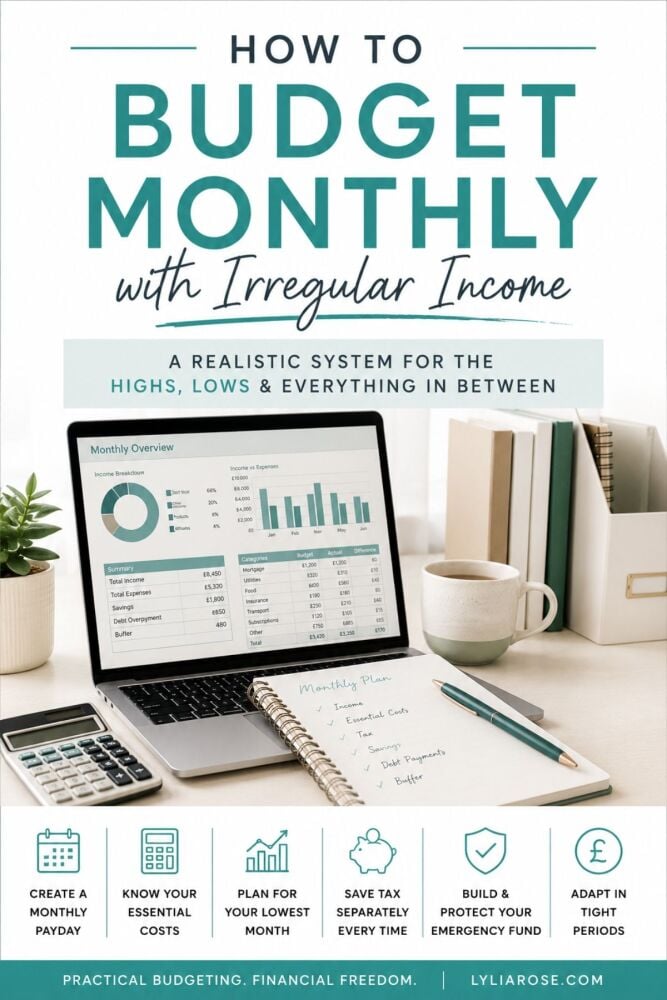
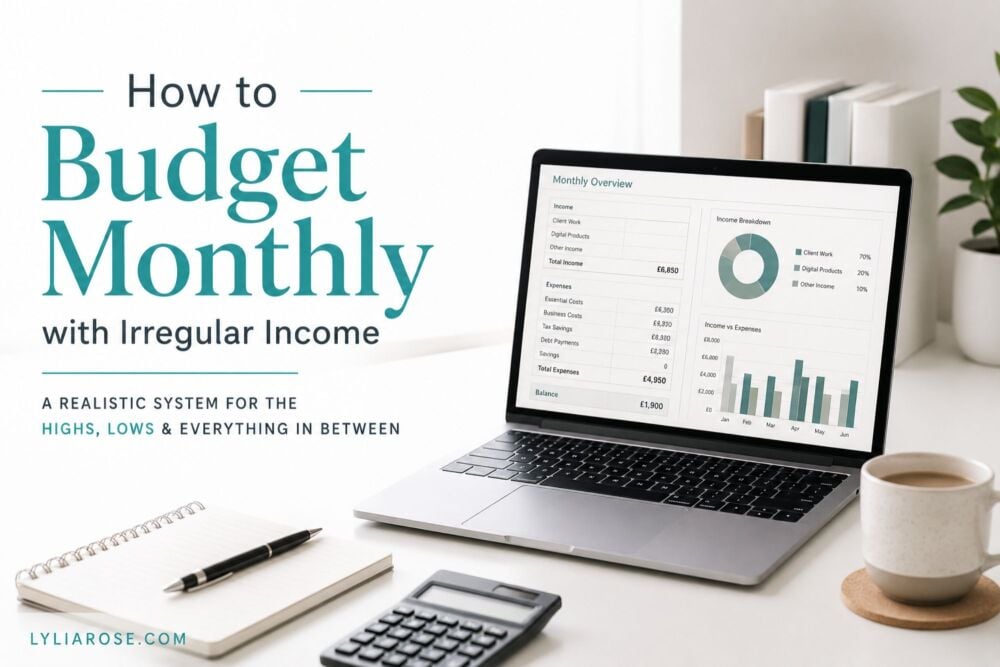
How to Budget Monthly with Irregular Income
Posted on
Budgeting with irregular income is something I've been doing for years. My husband Ben and I are both self-employed, which means neither of us has a fixed monthly salary, an employer pension, sick pay, or holiday pay. What we have is income that fluctuates month to month, sometimes significantly, and a system we've built over time to manage that as well as we can.
I won't pretend it's always easy. There have been periods where one of us has had a low month and the other has covered it. There have been harder periods where both have dipped at the same time, and those are genuinely stressful. Right now is one of those periods. Ben's income has dropped significantly and mine is also lower than usual, and we are watching every penny, selling things on eBay, and being more careful than we've had to be for a while.
But we have a system. And that system is the reason we're managing rather than spiralling. Here's what it looks like.
Create a "payday" at the end of the month
This is the single most useful thing we've done and something I haven't seen described elsewhere.
When you're self-employed, income arrives at unpredictable times throughout the month. Trying to budget week by week as money comes in is chaotic and exhausting. Instead, we treat everything that comes in during the month as income for that month, and we have a "payday" at the end of the month, just like an employed person would.
All income sits in the account throughout the month. At the end of the month, we review where we are, transfer what we need into our joint spending account, set aside tax, and decide how much to save or use to overpay debts based on how the month has gone.
This approach creates a rhythm. It makes irregular income feel manageable because you're always working within a monthly structure rather than reacting to every payment as it arrives.
Know your essential monthly costs to the penny
Before anything else, you need to know exactly what you must spend each month to keep your household running. Not an estimate - the actual figure.
I manage our finances on spreadsheets and track everything. I know our fixed costs precisely: mortgage, utilities, insurance, subscriptions, minimum debt repayments, food, school costs, everything. This is the number we must hit every single month regardless of what we earn.
My post on how to properly manage your salary and budget throughout the month covers the mechanics of this in more detail.
Everything above that figure is where the decisions get made - how much to save, how much to overpay on debt, whether we can spend on anything extra.
Knowing your baseline figure is essential when income is irregular. It tells you immediately whether a given month is comfortable, tight, or genuinely difficult.
Budget based on your lowest realistic month
When income is irregular, optimism is dangerous. We plan based on a cautious income estimate rather than assuming things will stay good.
If last month was excellent, we don't spend as if next month will be the same. We save in good months specifically because we know a lower month will come. When things are going well, we overpay debt, top up savings, and put more aside for tax. When things are tight, we already have that buffer to draw on.
The psychological shift this requires is real. When money comes in, the instinct is to feel secure and spend. Resisting that and thinking "next month might be harder" is what protects you when it is.
Separate tax immediately and don't touch it
This is non-negotiable when you're self-employed. Income tax and National Insurance don't get deducted at source - you receive your full income and it's your responsibility to save the tax portion. Spending tax money because it's sitting in your account is one of the most common and damaging mistakes self-employed people make.
We save a percentage of income for tax every month and treat that money as gone. It is not available. It is not a buffer. It sits in a separate account until HMRC needs it. My post on how to be tax ready when self-employed covers this in more detail.
The complexity for us is payment on account. HMRC estimates your tax bill for the current year based on the previous year's earnings, so if you had a good year last year, you're required to make advance payments assuming you'll earn the same again.
If your income then drops, you're still obligated to make those payments or risk a penalty of 7.5% per day on any underpayment if you reduce the payments and then unexpectedly earn the same as last year, or more. This creates real pressure when income varies significantly year to year, and even month to month.
It's one of the less discussed realities of self-employment and something that catches people out. Keep your tax savings separate and try to always save slightly more than you think you'll need.
Build and protect an emergency fund
An emergency fund is important for everyone but it is absolutely critical when you're self-employed. There is no redundancy pay, no sick pay, no employer to catch you if things go wrong. You are your own safety net.
We currently have an emergency fund of £10,000, which covers roughly three months of essential household expenses. That fund lives in a separate savings account and we treat it as untouchable except in genuine emergencies.
It was previously higher, but we needed it. When our daughter was seriously ill and spent 15 days in hospital, followed by two months off school requiring care at home, our ability to work was significantly reduced. The emergency fund meant we could focus on her without the financial panic that would otherwise have consumed us. We needed some food and day-to-day living costs covered while our income was reduced, and also took some out to pay down some car debt to reduce the minimum payment and give us some financial relief.
The emergency fund was there for exactly the reason we built it.
How much you need in an emergency fund depends on your essential monthly costs. Three months is a widely recommended minimum. For dual self-employed households where both incomes could drop simultaneously (and we are living proof that this happens), aim for more if you can.
In good months, do more than just spend
When income is strong, the temptation is to relax. We've learned to use good months actively rather than passively.
Good months are when we overpay debt to reduce monthly commitments. They're when we top up the emergency fund if it's been used. They're when we contribute to our LISAs (Lifetime ISAs) for retirement saving, since we have no employer pension and cannot rely on someone else contributing for us. We might stock up the pantry and the freezers. They're when we get ahead so that a harder month doesn't hit us from a standing start.
This requires discipline. It means not treating a good month as permission to spend freely. But the protection it gives you when things get harder is significant.
Reduce outgoings in tight periods
When income drops, the fastest lever you have is cutting what goes out.
We review subscriptions, reduce any discretionary spending, cook more at home, and look at everything we can temporarily reduce or pause. It's not about dramatic cuts but about being honest and systematic.
We also sell things on eBay when money is tight. A clearout of things we no longer need generates useful cash for smaller extras that would otherwise feel out of reach, like new school uniform or a birthday treat for one of the children. It also feels productive rather than passive, which matters when financial stress is draining.
Right now I have almost 300 items for sale on my personal eBay!
It sounds a lot, but we’re a household of four, and I’ve ruthlessly been through our attic, garden sheds, every drawer in the house, the kids clothes and toys and listed as much as I could find from clothes and toys to books and plant pots, and even individual hot tub parts that came with a hot tub we used to own in better financial times - spare and replacement parts sell surprisingly well on eBay!
My best tip, if it’s overwhelming, would be to find three items a day you can list. Do this every day for a month, and you’ll have 100 items listed by the end of the month!
Deal with the stress honestly
I want to say this because most budgeting articles don't: managing irregular income is genuinely stressful, and pretending otherwise helps no one.
When both our incomes are down at the same time, as they are right now, it affects everything. The mental load of watching every penny, making decisions you'd rather not have to make, worrying about what next month might look like. It takes energy.
What helps us is talking about it openly rather than one person carrying it silently, having a clear picture of where we actually are (spreadsheets help enormously here), and focusing on what we can control. We can reduce outgoings. We can look for additional income. We can protect the emergency fund. We can make a plan.
We’re still stressed, but having a plan and being productive and resourceful does help!
We can't control when the next good month arrives. But we can control how prepared we are when it does.
For more on managing financial stress in a relationship, my post on how to deal with financial stress in a relationship covers the emotional side of this in more depth.
And if you're looking for ways to boost income during quieter periods, my post on 60 ways to make money online at home has plenty of practical ideas.
The things employed people don't have to think about
For anyone moving from employment to self-employment, or anyone who hasn't experienced irregular income before, here are the additional financial pressures worth being aware of:
Tax and National Insurance must be saved from every payment by you, as they are not deducted at source. When you're employed, your employer handles this. When you're self-employed, you receive your full income, and it's entirely your responsibility to put the right amount aside. Spend it before your tax bill arrives, and you'll be in serious trouble!
You're not guaranteed 40 hours of work at a set pay every week. You have to go out and get the work, win the clients, complete the jobs, and keep it all coming in consistently to get paid. There is no guaranteed income, no floor, no safety net. Some weeks are full, some are quiet, and you can't always predict which is coming.
Payment on account - advance tax payments based on the previous year's earnings - which can create pressure when income drops.
No employer pension contributions. You save for retirement entirely yourself. My post on the Moneybox Lifetime ISA explains how we use LISAs and why they're worth considering for the self-employed.
No sick pay or holiday pay. Every day you don't work is a day you don't earn.
Business expenses that come out of your income before it can be used personally.
These aren't reasons not to be self-employed. But they are reasons to budget more carefully and keep more in reserve than an employed person might need to.
Before you go...
If you're building financial resilience alongside budgeting, my post on how to build an emergency fund when your income varies covers the savings side of this in detail.