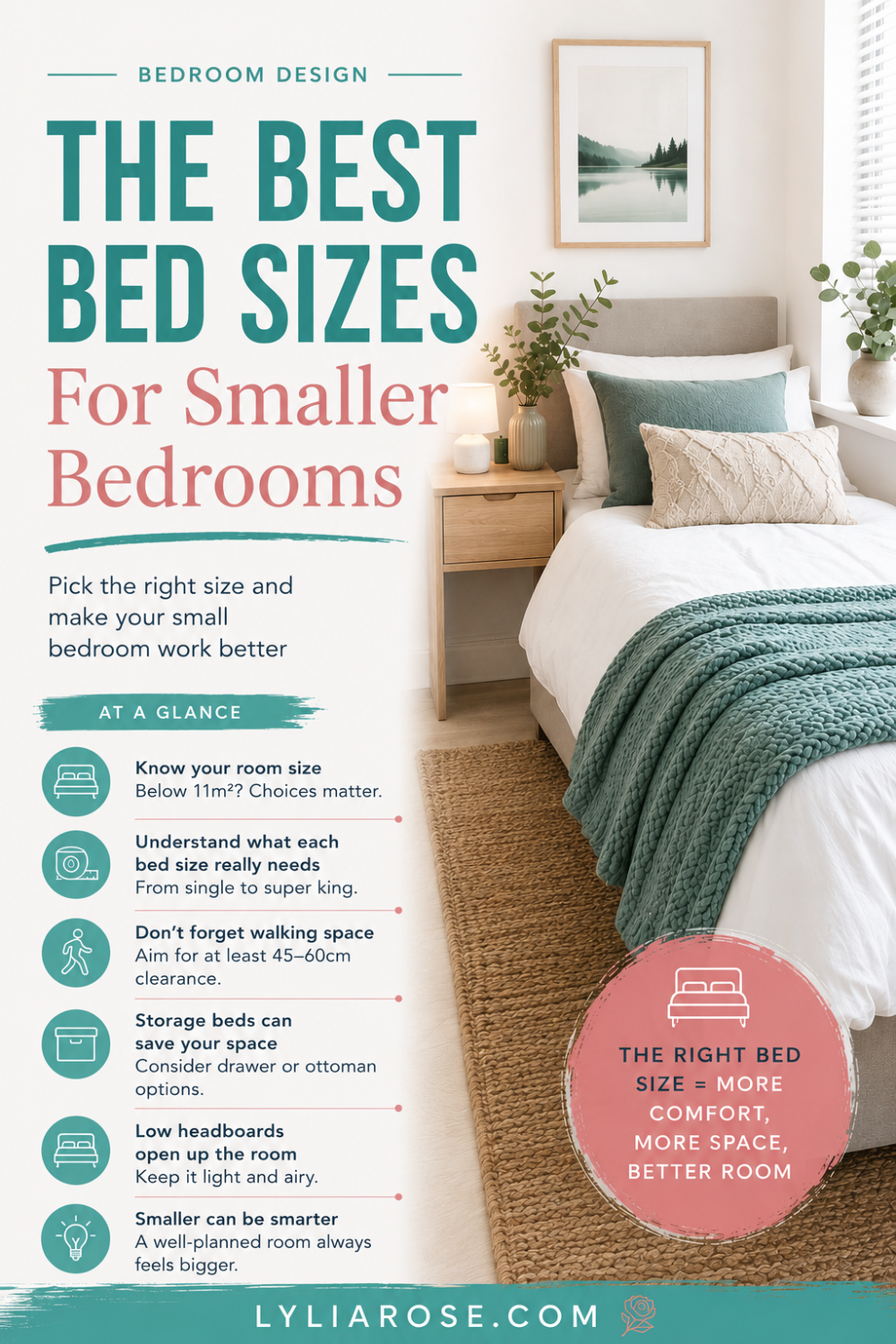
The Best Bed Sizes For Smaller Bedrooms
Posted on

Small bedrooms are punished by bad bed choices in a way larger rooms aren't. A king-size bed in a generously proportioned room is just a king-size bed. The same bed in a small room becomes the entire room, eating wall space, blocking access, and making everything from getting dressed to opening drawers a daily negotiation. Choosing the right bed size for a small bedroom is one of those decisions where smaller is often better, and most people resist that conclusion until they've experienced the alternative.
What Counts As A Small Bedroom
UK bedroom sizes have shrunk over the decades, and many new-build flats and houses include rooms that would historically have been considered single rooms but get marketed as doubles. A "double" bedroom under current marketing conventions might be 8-9 square metres, which is genuinely tight for any bed bigger than a small double once you factor in walking space and other furniture.
The honest floor area where bed choice gets difficult is anything below about 11 square metres. Above that, a standard double with sensible clearance works comfortably. Below it, decisions start to matter, and the smallest rooms (under 8m²) restrict your choices significantly.
The room shape matters too. A long narrow room of 10m² behaves very differently from a square one of the same area. Long narrow rooms can sometimes take longer beds (king-size) along one wall and leave usable space alongside, while square rooms with the same area might require a standard double oriented differently.
What Each Bed Size Actually Demands
A single bed (90cm wide) needs roughly 2m of length plus turning space at one or both ends. With clearance on one side, this works in rooms as small as about 6m² without feeling cramped.
A small double, sometimes called three-quarter (120cm wide), gives more sleeping width while remaining usable in rooms around 7-8m². This is one of the most useful sizes for solo sleepers in small rooms who want more space to move than a single provides.
A standard double (135cm wide) needs roughly 9-10m² to work properly with bedside tables and walking space. Below that floor area, you can fit a double, but the room will feel tight.
A king-size bed (150cm wide) really wants 11m² or more. You can squeeze one into 10m² if the layout is exactly right, but the result usually feels cramped.
A super king (180cm wide) is impractical in any room below about 13m². It can be done, but the room becomes a bed-with-walking-strip rather than a functional bedroom.
The Walking Space Question
Furniture catalogues quote bed dimensions, but they rarely quote the walking space the bed requires. This is where people get tripped up. A standard double's 135cm × 190cm footprint sounds modest, but functional access needs another 60cm on at least one side and 60cm at the foot, which adds up to roughly 2.5m × 2.5m of effective room space.
The minimum walking clearance most people can live with is around 45cm. Below that, you're squeezing past the bed daily, which is mildly unpleasant on its own and becomes seriously annoying when you have to carry anything, fetch something from the wardrobe, or navigate around the bed in the dark.
For couples sharing a small room, walking space on both sides of the bed becomes essential rather than optional. One person being able to leave the bed without disturbing the other requires unobstructed paths on both sides. If your small room only has space for clearance on one side, sharing the bed becomes more disruptive than it would otherwise be.
The Counterintuitive Math
In small bedrooms, the bed that produces the best overall functionality is often smaller than the one you'd choose without thinking. A small double in a tight room often beats a standard double, even though the standard double offers more sleeping space, because the small double leaves room for proper bedside tables, clear walking access, and the small additional storage that makes the room work.
The same logic scales up. A standard double in a marginal room beats a king-size that fills the room. The extra 15cm of sleeping width on the king-size costs you the room's functionality, and most people don't gain enough sleep benefit to justify that loss.
This is harder to internalise than it sounds. The intuition is always to go bigger when possible. The reality is that small rooms reward restraint, and the comfort you'd gain from a slightly bigger bed is usually less than the comfort you'd lose from a less functional bedroom.
Where Storage Beds Pay Off
Small bedrooms tend to have limited storage capacity, which is why beds with built-in storage make particular sense at the smaller sizes. A small double or standard double with drawers or a lift-up ottoman base provides storage that would otherwise have to come from a chest of drawers, freeing up floor space for other things.
The trade-off is that storage beds are typically slightly heavier and require more space around them to access the storage (you need to be able to pull out drawers or lift the base fully). In a very tight room, this access requirement can offset some of the storage gain.
When you browse compact bed designs, it's worth noting which storage configurations work in your specific layout. Side-opening drawers need clearance to one side; foot-end ottomans need clearance at the foot. The wrong storage orientation can be useless even if the bed itself fits.
Headboards In Small Rooms
Tall headboards make small rooms feel smaller. The eye reads vertical mass, and a tall headboard adds visual weight to the largest object in the room, making the whole space feel more compressed.
For small bedrooms, headboards that are low to medium height (50-80cm above the mattress) tend to work better visually than taller alternatives. The bed reads as more proportionate to the room, and the visual space above the bed stays open, which makes the room feel less crowded.
Wall-mounted headboards (not attached to the bed frame) can work well in tight rooms because they free up a tiny bit of floor space that bed-frame-mounted headboards take up. The difference is small but real in a marginal room.
The Door Swing Trap
Many small bedrooms have doors that open inward, and the door swing eats into the available floor area. A bed positioned where it conflicts with the door swing creates a permanent obstruction; the door can't fully open, or it swings against the bed and develops scratches over time.
When you measure for a bed, draw the door swing on your floor plan. The bed can't be in that arc. This sometimes eliminates a wall that would otherwise have worked, forcing you to a different bed position than you'd intended.
For rooms where door swing is a problem, sometimes the answer is rehanging the door to open outward into the hall (where this is possible) or using a smaller bed that fits within the constrained area. Neither solution is perfect, but acknowledging the constraint early is better than discovering it after delivery.
The Honest Answer
If you have a small bedroom, your bed options are more limited than the bedding industry's marketing would suggest, and accepting the constraints produces a better room than fighting them. A small double or standard double, with built-in storage, a low-to-medium headboard, and proper attention to walking space and door swing, produces a small bedroom that functions well. A king-size in the same room produces frustration. The smaller bed is the better choice, even though the marketing rarely tells you so.