How to Switch Off When Self Employed Without Losing Income
Posted on
If you’re self-employed, you’ll know this isn’t as simple as just closing your laptop.
There’s always something else you could be doing. Another task, another idea, another way to move things forward.
And when your income depends on it, switching off can feel uncomfortable, even risky.
But the truth is, not switching off comes with its own cost. Lower energy, slower thinking, and eventually burnout.
So the goal isn’t to stop working altogether. It’s to find ways to step back without affecting your income long-term.
Why switching off feels almost impossible
When you work for yourself, there’s no clear end to the day.
Your work doesn’t stay in one place. It follows you around, mentally if not physically.
And it’s not just one role you’re managing.
You're doing everything. The planning, the admin, the marketing, the customer service, the accounting, the sales, the ideas, the problem-solving, oh - and the actual work itself! It's why time management tips for working from home are so much harder to apply when you're also the one creating the work in the first place.
That constant mental load makes it hard to ever feel “done”.
The reality behind self-employment
I’ve been self-employed since 2013, and working solely for myself since 2016.
So I know first-hand how hard it is to switch off.
Since 2019, I’ve also been the main income provider for our household, which adds another layer of pressure. Maintaining and increasing income each year isn’t optional.
It means there’s always that feeling that you should be doing more.
I work completely alone, so everything comes back to me.
I handle the accounts, the SEO, the content, the website, the emails, the ideas, the growth. It’s constant.
Evenings often don’t feel like downtime. More like an extension of the working day.
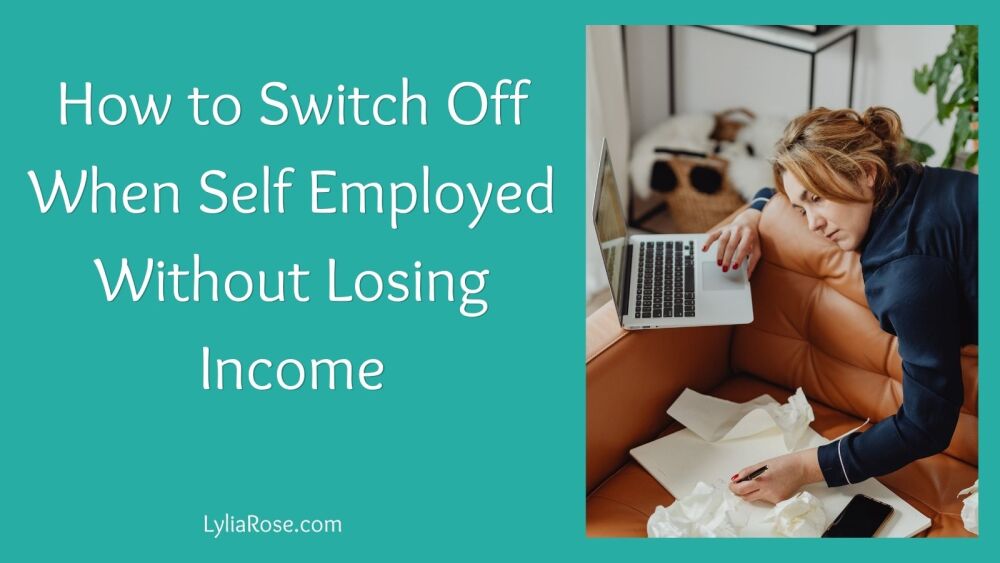
Right now, I’m sat in bed with my laptop propped up on a pillow, still working. And I’ll probably carry on for another couple of hours until I’m too tired to continue.
I've written before about the things I sacrifice to be self-employed, and evenings and weekends are near the top of that list.
That’s just how it goes sometimes. Well, most of the time!
Why weekends don’t always feel like a break
People often assume weekends are when you switch off.
But when you’re self-employed, it’s rarely that simple.
I often still work at the weekend. Sometimes it’s catching up. Sometimes it’s getting ahead. Sometimes it’s just the only quiet block of time, without the pre- and post-school busyness, to focus.
But I’ve learned to pay attention to how I’m feeling.
If I start to feel properly burnt out, that’s when I step in and take both days off completely.
No laptop. No emails. No, “just checking something quickly”.
Instead, I’ll focus on something else entirely. Gardening, going for a beach walk, or heading out somewhere new for the day.
It doesn’t always feel easy to do, but it’s necessary.
Because pushing through burnout never ends well.

What actually helps you switch off
Switching off doesn’t mean doing nothing.
In fact, doing nothing often doesn’t work.
Scrolling your phone might feel like a break, but your brain is still active. Still processing. Still thinking.
What works better is doing something simple that shifts your focus.
For me, one of the biggest habits is starting the day before work begins.
I try to get up between 6 and 6.30 am and go for a run or a walk. Even if it’s just 30 minutes. Before the madness of our family household with the kids getting ready for school… then the workday starts all over again.
That time is mine.
Because I know that as soon as I check emails, my brain is in work mode for the rest of the day.
Practical ways to switch off without losing income
You don’t need a perfect routine. You just need small changes that work in real life.
A few things that make a difference:
-
Create space before work starts
Even a short walk or quiet moment can stop your day from being taken over straight away. -
Delay checking emails
Once you open them, your focus shifts to reacting instead of choosing what matters. -
Use your weekends flexibly
Some weekends might include work. Others need to be fully off, especially when you feel burnout building - and if you struggle with guilt around that, I've got a whole post on how to recharge on your day off without feeling guilty. -
Take proper breaks when needed
Not half breaks, not distracted breaks. Real time away from work.
Why simple creative breaks can help
One thing that works surprisingly well is doing something creative, but in a very low-pressure way.
Not something that takes planning or effort. Just something simple.
The reason it works is because it changes your mental state.
Instead of thinking about tasks, you’re focusing on something in front of you.
It gives your brain a proper pause.
This is where small, portable creative options can be useful.
They don’t require much time or setup, which makes them realistic to use.
For example, compact watercolour kits are designed to be quick and easy.
Options like pocket-sized watercolour sets like those from Tobios Kit's that include everything in one place, so you can pick them up, use them for a few minutes, and put them away again.
There’s no pressure to be good at it.
It’s just something simple to do that isn’t work, isn’t a screen, and doesn’t drain your energy.
Even a short break like that can help reset your focus.
Making switching off part of your routine
This is where it becomes a habit rather than something you think about.
You make it easy.
Keep whatever helps you switch off nearby. Build it into your day. Don’t rely on motivation.
And remind yourself that taking breaks isn’t losing time.
It’s protecting your ability to keep earning.
Because the reality is, working constantly without any breaks doesn’t make you more productive.
It just wears you down.
Finding a balance that works for you
There's no perfect balance when you're self-employed, and I think achieving a good work-life balance looks different for everyone.
Some days will be long. Some weeks will feel full-on. And sometimes, you’ll still be working in the evenings or at the weekend.
That’s part of it.
But knowing when to step back is just as important as knowing when to push forward.
Whether that’s a morning walk, a full weekend off when burnout hits, or a few quiet minutes doing something simple, those breaks matter.
They’re what allow you to keep going, without running yourself into the ground.
And in the long run, that’s what protects your income (and sanity) more than anything else.
You don’t need to switch off perfectly.
You just need to give yourself enough space to keep going.