Going Self-Employed? How to Be Financially Secure
Posted on
Many people believe being self-employed or running your own business is the dream. It's a lifestyle that many are envious of and wish they could pursue themselves.
The thing is, anyone can choose to be self-employed and set up their own business, but being successful at it is another story entirely.
When you take the leap into self-employment, it's exciting, but it is not without fear. You are suddenly on your own and dependent upon yourself to make a living. There's no guaranteed pay cheque at the end of the month, and this can cause a lot of stress and anxiety if you're not financially prepared.
I've been self-employed since 2012 and went full-time in 2017. My husband Ben has been full-time self-employed since summer 2019. Here's everything I'd want someone to know before taking that leap.
Make sure you're really ready
My best advice is to make sure you're ready to commit before you leave employment. It's very rare that people quit their jobs and start their self-employed adventure from scratch, and I wouldn't advise it.
I still worked in employed jobs whilst I started my business, until it was off the ground and making enough money for me to commit full-time. Once my business was making a full-time income for six months straight, I quit my last employed job and dedicated all my time to my business.
Ben also started his business around his full-time job - working evenings, weekends and annual leave - to ensure there was real demand before leaving the security of regular employment.
It takes time, sometimes months or even years, to build a business to a sustainable income. Be sensible and don't put yourself in financial difficulty by quitting before you know your self-employment will work.
Save as much as you can before you go full-time
If at all possible, save hard before making the jump.
We did this before Ben quit his job. I was already self-employed without a guaranteed income and we had two young children and a mortgage. It was genuinely scary for neither of us to have a guaranteed income, so we hard-core saved for the last year that Ben was employed.
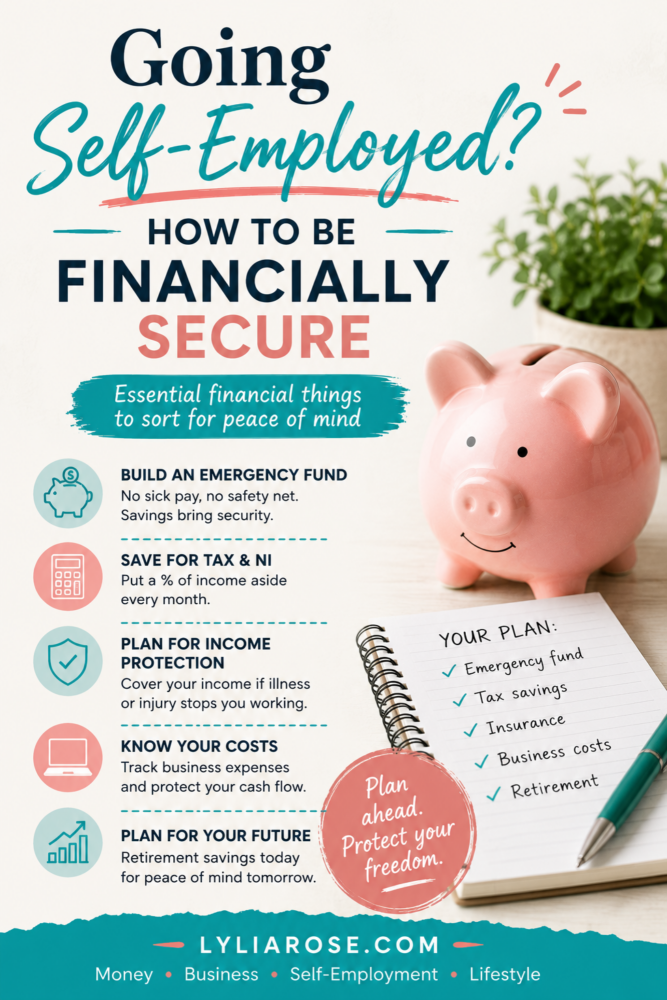
Those savings became our emergency fund - an absolute last resort, not just for a rainy day, but to cover us for sickness or injury if we genuinely cannot work. When you're self-employed there is no sick pay. You're on your own financially in all circumstances.
A substantial emergency fund gives you real peace of mind when things get quiet or go wrong.
Get a month ahead on finances
It's also a good idea to get at least one month ahead when it comes to your personal finances. You never know when you'll have a quiet month, lose a client, or face an unexpected situation that reduces your income.
Having one month's income saved beyond your emergency fund means you can absorb a difficult month without panic and without dipping into your emergency fund.
Keep a buffer in your business account
My husband and I both keep a buffer in our business bank accounts. This covers regular business outgoings and gives a cushion for anything unexpected - a larger than expected bill, a customer return in Ben's furniture business, or simply a slower payment from a client.
We always know what our regular bills and outgoings are each month, but this buffer means we're never at risk of going overdrawn. It's another layer of financial security that genuinely reduces the day-to-day anxiety of self-employment.
Income protection
I'll be honest, this is something we still haven't done, but I've looked into it and it's worth considering seriously - especially if you have a mortgage or dependants.
Income protection provides a monthly payment if you can't work due to illness or injury. Different policies cover different amounts, typically 50-70% of your usual income, but higher cover is available for a higher premium.
If you couldn't cope financially for several months without any income, and have no other safety net through savings or a partner's income, income protection is worth looking into seriously.
No sick pay and no paid holiday
As well as no sick pay, there's no paid annual leave when you're self-employed. It's one of the many realities of working for yourself.
This means you either need to save during the year to cover holidays, or continue working while you're away. My laptop comes on every holiday and I work mornings and evening remotely, so I can do this without losing clients or income.
Not every business can work this way, and you may not want to. So make sure you plan for it financially - time off when self-employed costs you the income you would otherwise have earned.
Know your business costs
Don't forget about your business expenses when you're working out how much you need to earn. They eat into profit and need to be factored in from the start.
Business costs vary enormously depending on what you do, but can include website costs, software subscriptions, business insurance, business banking, equipment, stock, an accountant, and any hired help. Know your numbers before you commit.
Sort your accounting and tax savings
When you're self-employed, you're responsible for documenting all income and outgoings, calculating your profits, and paying your taxes. You need to be organised and submit your self-assessment on time every year.
I have a separate savings account purely for tax, National Insurance and - in our case - student loan repayments. Ben still has a student loan being repaid through self-assessment, so that gets factored into what we save each month. If you have a student loan, don't forget it doesn't disappear when you go self-employed - it continues to be collected through your tax return once your income is above the repayment threshold.
I put a set percentage of earnings into my tax savings account every month, so when the self-assessment payments fall due in January and July, the money is already sitting there. The exact percentage to save depends on your income - I've covered this and more in my tax tips for bloggers and self-employed people.
One important thing to be aware of: Making Tax Digital (MTD) is now being rolled out for self-employed people. If your gross income was over £50,000 in 2024/25, MTD applies to you from April 2026 - meaning quarterly digital reporting rather than just an annual return. The threshold drops to £30,000 from April 2027 and £20,000 from April 2028. Worth knowing about before it catches you off guard.
Retirement
There's no workplace pension and no employer contributions when you're self-employed, so you need to sort your own retirement savings.
I save into a savings account for retirement and also into a retirement LISA, which gives a 25% government bonus of up to £1,000 per year on savings up to £4,000. You can only open a LISA before age 40 and contribute until age 50, so if you're eligible, it's worth starting sooner rather than later, especially as the current government plan to stop them.
A self invested personal pension (SIPP) is the other route - contributions get tax relief, which makes them very efficient for self-employed people. Many people do both.
Don't rule out getting a job
Something my husband and I have always been clear on is that we'd get a job if things stopped working. If either of us went months without making money, we'd get a part-time job while we pivoted or rebuilt. Self-employment might be the dream, but if it's genuinely not working and you're struggling financially, getting a job while you figure it out is the sensible move. Not a failure - just a practical one.
Final thoughts
Going self-employed is genuinely exciting, but financial security takes planning and discipline. Sort the foundations before you make the leap - emergency fund, tax savings, an understanding of your costs - and the day-to-day reality of self-employment becomes far less stressful.