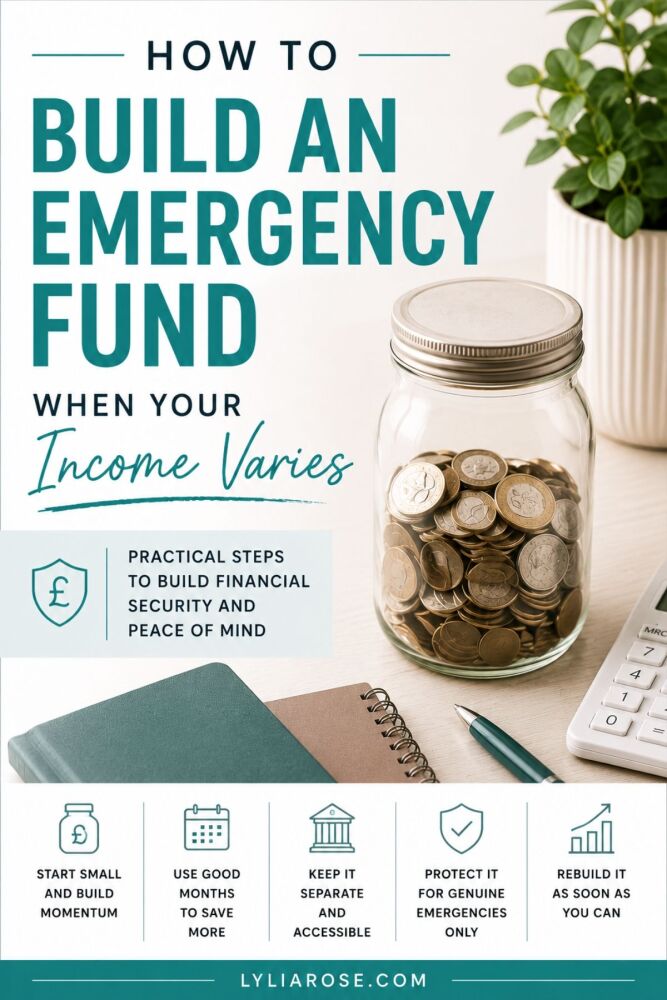
How to Build an Emergency Fund When Your Income Varies
Posted on
An emergency fund is one of those things that sounds sensible in theory but can feel almost impossible to build when your income isn't predictable. When some months are tight and others are better, saving feels like a luxury rather than a priority.
I understand that feeling. My husband Ben and I are both self-employed, which means our household income fluctuates constantly. There have been months where we've saved well and months where we've had to be extremely careful. Building our emergency fund took time and discipline, and there were periods where contributing to it felt impossible.
But we did it. And we have needed it. More than once.
Here's how we built our emergency fund and why, if you're self-employed or have irregular income, it matters more than almost anything else you could do financially.
What an emergency fund actually is
An emergency fund is a pot of money set aside specifically for unexpected expenses or sudden drops in income. It's not your savings for a holiday or a new car. It's not money you dip into for everyday overspending. It's a financial safety net that exists for genuine emergencies only.
For self-employed people, this definition is broader than it might be for someone in employment. An emergency isn't just a broken boiler or an unexpected car repair (though those count). It's also a bad month, a lost client, a period of illness, or any situation that significantly reduces your ability to earn.
When you have no employer to pay you sick pay, no redundancy package if work dries up, and no guarantee of what next month looks like, your emergency fund is your employer. It's your safety net. It's the thing that means a difficult period doesn't become a financial crisis.
How much should you save?
The commonly cited figure is three to six months of essential expenses. For people with irregular income, aim for the higher end of that range if you can.
Work out your non-negotiable monthly costs: mortgage or rent, utilities, food, insurance, minimum debt repayments, school costs, anything that must be paid regardless of what you earn. Multiply that figure by three to get your minimum target, and by six if you want more security.
We set our target at £10,000 initially, but we actually built our emergency fund up to £18,000 at its peak - around six months of our essential household expenses. That felt genuinely secure. Right now, following our daughter's illness with two months off school and an extended hospital stay and a period of reduced income for both of us, we're sitting at £10,000. We've used £8,000 of it, partly to cover the period when our ability to work was reduced, and partly to pay down a car loan to lower our monthly outgoings while income has been lower than usual.
£10,000 covers roughly three months of our essential costs. It's reassuring that it's there, but I won't pretend I'm not a little worried about it being lower than it was. Six months felt safe. Three months feels adequate but fragile. The goal, as soon as things stabilise, is to build it back towards that higher figure, but for now we're holding firm at £10,000 and treating it as absolutely untouchable.
Start smaller than you think you need to
If three months of expenses feels completely out of reach, start with a much smaller target. Even £500 or £1,000 in a separate account can prevent you from reaching for a credit card when something unexpected happens.
The first £1,000 is the hardest. Once it's there, it builds momentum. You see the number growing, you feel the security of having something behind you, and it becomes easier to keep contributing.
We saved our emergency fund gradually over time, adding to it in good months and leaving it alone in tight ones. There was no single dramatic moment where we swept a large sum into it. It was small consistent contributions over a long period, boosted significantly whenever we had a better month than expected.
My post on how we saved £6,500 in 6 months to reach our 10k emergency fund goal covers exactly how we saved our first £10,000 emergency fund it if you want the practical detail.
Use good months to build it faster
This is the most important thing you can do with irregular income. When a good month arrives, resist the temptation to spend it all. A portion of every better-than-expected month should go straight to the emergency fund until you hit your target.
We don’t just enjoy the extra spending money when we have a good income month. We use good months to save more, overpay debt, and get ahead. The emergency fund was always one of the first things we prioritised in those months, because we knew a quieter month could come at any time. That discipline is what got us to the £18,000 we did have.
Once you've reached your target, good months can then go towards other goals - overpaying the mortgage, investing, saving for something specific. But until the emergency fund is in place, it should come first.
Keep it in a separate account
This is non-negotiable. If your emergency fund lives in the same account as your everyday spending, it will gradually disappear. It needs to be physically separate so you can see its balance clearly and aren't tempted to dip into it for non-emergencies.
We keep ours in a dedicated savings account. It's accessible if we genuinely need it, but it's not visible in our day-to-day banking view. Out of sight enough to feel separate, accessible enough to reach quickly if something serious happens.
A straightforward easy-access savings account works well. You don't need a high-interest product specifically for this pot - accessibility matters more than interest rate for an emergency fund.
Or, what we’ve done as we don’t plan to touch it aside from emergencies, is to use an ISA with an OK interest rate, better than most savings accounts, but within limited withdrawals per year. We can withdraw four times each calendar year without losing the special interest rate. If we withdraw a fifth time, we’re put on a lower interest rate. This limit helps us resist the urge to dip in for small overspends every now and then as we don’t want to lose the good interest rate and only use the account for emergencies.
What counts as a genuine emergency
This is worth thinking about before you need to use it, because in a moment of financial stress everything can feel like an emergency.
Genuine emergencies include: a significant drop in income that your monthly budget can't absorb, an unexpected essential expense (boiler breakdown, urgent car repair, medical costs), or a family situation that prevents you from working normally.
We've used ours twice in ways that felt entirely justified, and between the two situations we've gone from £18,000 down to £10,000.
The first was when our daughter became seriously ill. She spent 15 days in hospital and then couldn't attend school for two months, requiring one of us to be with her all of the time. Our ability to work was significantly reduced during that period. The emergency fund didn't solve everything, but it meant we could focus on her without financial panic consuming us at the same time. That was exactly what it was there for.
The second is ongoing. Ben's income has dropped significantly over the past few months, and mine is also slightly down. We've used some of the fund to pay down a car loan, reducing our monthly outgoings while income is lower.
We're now firmly at £10,000 and we're not going below that. It covers three months of essential costs, which is reassuring, but I'd be lying if I said I wasn't a little unsettled after being at £18,000. Three months cover feels adequate; six months felt genuinely secure. Rebuilding towards that higher figure is the plan as soon as income recovers.
Balance saving with debt repayment
One of the most common questions is whether to pay off debt first or build an emergency fund. The honest answer is: both, in balance.
If you have high-interest debt, it might feel counterproductive to save when that debt is costing you money. But having no emergency fund means any unexpected expense goes straight onto a credit card, making the debt worse. A small emergency fund alongside minimum debt payments is better than no fund at all.
Once you have a starter fund of around £1,000, you can shift focus to clearing expensive debt more aggressively, then build the fund back up once the debt is gone. But as this article is about variable incomes, for us at least, we made sure we saved an emergency fund before overpaying on our debts as we needed the security income-wise as we aren’t employees and our business income fluctuates.
My post on 4 rules for preventing future debt and mastering your finances covers the debt side of this in more detail.
Protect it fiercely once it's built
Getting to your emergency fund target is an achievement. Keeping it there requires just as much discipline.
The temptation when money is tight is to dip into the emergency fund for things that feel urgent but aren't genuine emergencies. A big purchase you want to make, a month where you've overspent, a shortfall that could actually be covered by cutting back elsewhere. These aren't what the fund is for.
We have a clear rule: the emergency fund is only for situations that genuinely cannot be managed any other way.
Selling things on eBay, cutting back on discretionary spending, delaying a non-essential purchase - these come first. The fund is the last resort, not the first.
What to do when you've had to use it
If you've had to draw on your emergency fund, the priority as soon as things stabilise is rebuilding it. Even small contributions help. The goal is to get back to your target as quickly as reasonably possible without creating stress in the meantime.
We're in this position right now. We've used some of our fund and we want to rebuild it. We're not able to contribute while our income is lower, but we're not spending it further either. As soon as things improve, rebuilding the fund will be the first financial priority.
That's the mindset: use it when you genuinely need to, rebuild it as soon as you can, and don't feel guilty for using it for exactly the purpose it was built for.
For more on managing your finances as a self-employed person, my post on how to budget monthly with irregular income covers the budgeting system we use day to day.
And for ideas on boosting income during quieter periods, 60 ways to make money online at home has plenty to explore.
Before you go...
If you found this useful, you might also want to read: