3 Carat Diamond Rings Explained: Size, Price and the 3 Cs
Posted on
A 3 carat diamond ring is a serious piece of jewellery, whether it's for an engagement, an anniversary or simply something you've decided to treat yourself to. But before spending anything close to that kind of money, it helps to actually understand what you're looking at. Carat weight alone doesn't tell you how big a diamond looks, what it might cost, or whether it's genuinely good quality. This guide breaks down the size, the price and the 3 Cs so you know exactly what you're paying for.
What Does 3 Carat Actually Mean?
Carat is a measurement of weight, not size. One carat equals 200 milligrams, so a 3 carat diamond weighs 0.6 grams in total. That's it. It says nothing on its own about how the diamond will actually look on a hand.
This is where a lot of buyers get caught out. Two diamonds can both weigh exactly 3 carats and still look completely different sizes, because how a diamond is cut has a huge effect on how much of that weight translates into visible size and sparkle. A diamond cut too deep hides weight underneath where nobody sees it. A diamond cut well shows its full size across the top.
How Big Is a 3 Carat Diamond?
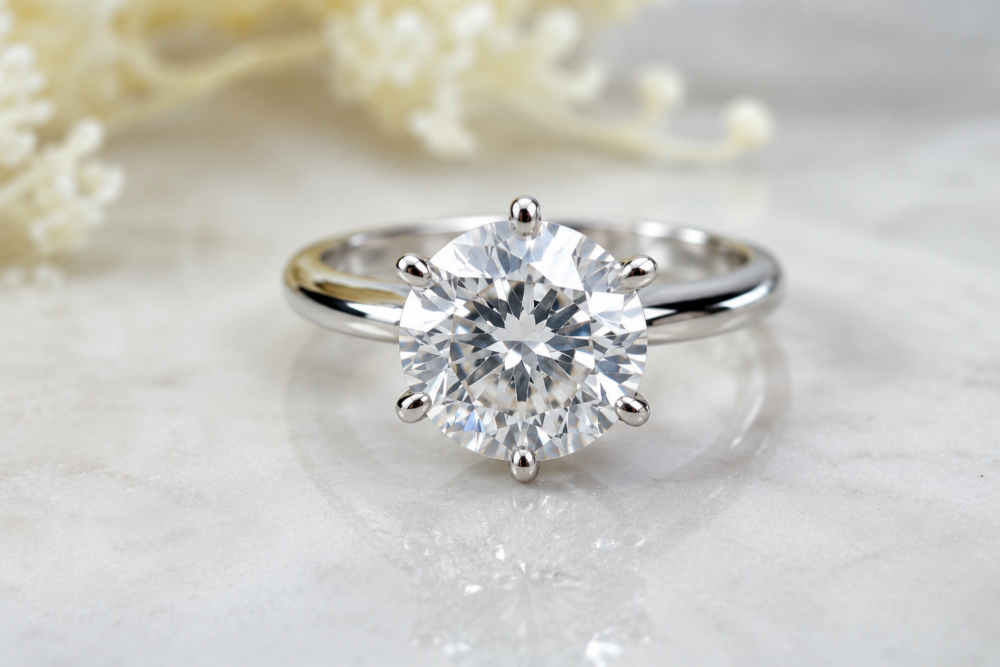
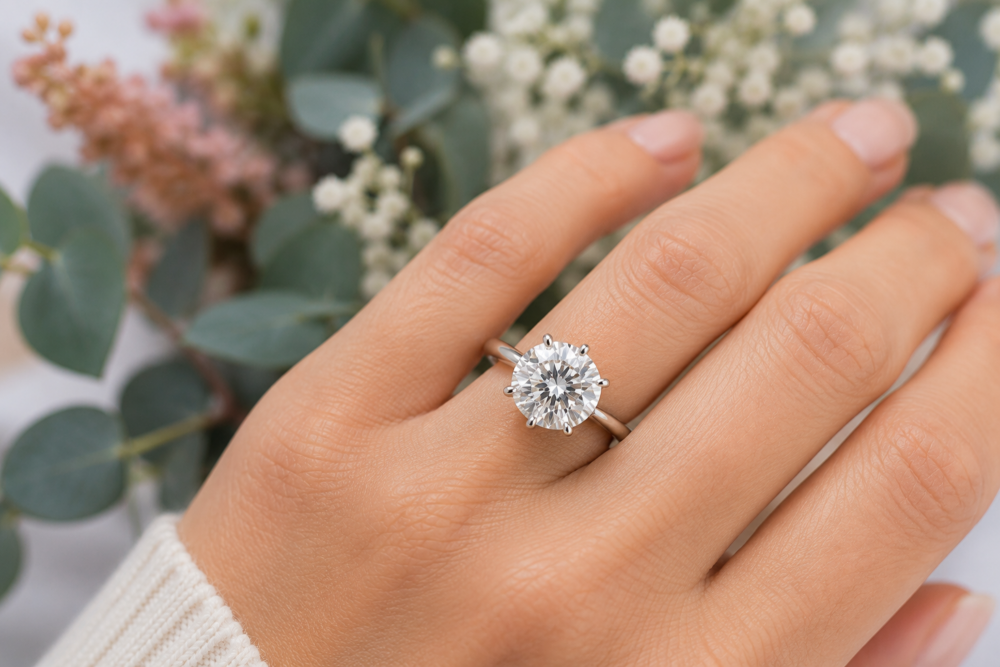
For a well cut round brilliant, a 3 carat diamond typically measures around 9.2 to 9.4mm across, with a depth of roughly 5.6 to 5.9mm. On the hand, that works out to a face-up area of around 68 to 69 square millimetres, close to the size of a UK five pence coin.
Here's a quick size reference for common cuts at 3 carats:
| Shape | Approximate size (mm) | Visual effect |
|---|---|---|
| Round brilliant | 9.2 to 9.4 diameter | Classic, maximum sparkle |
| Oval | 11 x 7.5 to 8 | Looks larger than round for the same weight |
| Emerald | 9.5 to 10 x 7 | Elegant, less sparkle, more clarity showing |
| Cushion | 8.5 to 9.5 | Softer outline, vintage feel |
| Pear | 12 to 13 x 8 | Elongated, dramatic on the hand |
If the main goal is a diamond that looks as large as possible, an elongated shape like oval or pear will generally appear bigger than a round diamond of the same carat weight, simply because more of the surface area is spread out rather than concentrated in a circle.
What Are the 3 Cs of Diamonds?
Most people have heard of the 4 Cs of diamonds (cut, colour, clarity and carat), but when it comes to what actually matters most for a 3 carat stone, it really comes down to 3 of those: cut, clarity and carat. Colour still plays a role, but at this size it's the other three that make the biggest visible difference.
Cut determines how much a diamond sparkles. This is not the same as shape. Cut refers to the precision of the facets, and it's the single biggest factor in how brilliant a diamond looks, regardless of size.
Clarity refers to internal or surface flaws. At 3 carats, any flaws are more visible to the naked eye than they would be in a smaller stone, simply because there's more surface area to look at.
Carat, as covered above, is weight, and at this size it has a disproportionate effect on price because larger stones are rarer.
Colour is still worth understanding briefly. Grades run from D (colourless) down through the alphabet, with D to F considered colourless, and G to H often looking equally white once set, particularly in white gold or platinum, while costing noticeably less.
Cut: Why It's the One to Prioritise
If there's one area not worth compromising on, it's cut. An "excellent" or "ideal" cut grade means the diamond has been shaped to reflect and refract light as effectively as possible. A poorly cut 3 carat diamond can genuinely look duller and smaller than a well cut 1.5 carat stone, because so much of its potential brilliance is lost.
This matters more at larger sizes, not less. A small cutting flaw is far more visible spread across a bigger surface.
Clarity: What You Can Get Away With at This Size
For a diamond this large, VS1 or VS2 clarity tends to be the sensible range. These grades are typically eye-clean, meaning no inclusions are visible without magnification, while still being considerably more affordable than flawless or internally flawless grades. Dropping below VS2 increases the chances that flaws become visible at this size, particularly in lighter coloured stones.
How Much Does a 3 Carat Diamond Ring Cost in the UK?
This is where natural and lab-grown diamonds diverge sharply, and it's worth understanding both before deciding what you actually want to spend.
| Diamond type | Typical UK price range | Notes |
|---|---|---|
| Natural mined | £40,000 to £150,000+ | Price driven by rarity, certification and demand |
| Lab-grown | £7,000 to £11,000 | Chemically identical, considerably lower cost |
These figures are for the loose diamond only. A setting typically adds another £700 to £3,000 depending on the metal and design.
The gap between natural and lab-grown has widened considerably as lab-grown production has scaled up, and for many buyers the ethical and environmental angle (no mining involved) is as much a factor as the price difference itself. Neither option is objectively the "right" choice. It depends on what matters most to you, whether that's rarity and resale value, or getting a visually identical stone for a fraction of the cost.
One quirk worth knowing: a diamond weighing 2.95 carats can be noticeably cheaper than one weighing just over 3.00 carats, purely because of how buyers psychologically respond to round number thresholds. If budget is tight, a diamond just under the 3 carat mark can be a sensible way to save money without any real visible difference.
If the price gap still feels too wide even with lab-grown, it's worth reading up on whether moissanite is worth buying as a genuine alternative. It shares many of a diamond's visual qualities at a fraction of the cost, and at 3 carats that difference in price becomes even more significant.
Another route worth considering is the pre-owned market. There are real benefits to buying pre-owned jewellery, particularly at this price point, since a previously owned 3 carat diamond can come with significant savings over buying new, without any real compromise on quality if it's sourced from a reputable seller.
Choosing a Setting for a 3 Carat Diamond
The setting affects both how the diamond looks and how well it's protected day to day.
A solitaire setting keeps things simple and lets the stone do the talking, which tends to suit a 3 carat diamond well since there's no need to add extra sparkle. A halo setting, where smaller diamonds surround the centre stone, can make the overall ring look larger still, though it's worth being careful not to overdo it, or the halo can compete with the main stone rather than complement it. A three-stone setting adds symbolic meaning (often read as past, present and future) and allows for contrast, such as pairing a round centre stone with baguette side stones. For a broader look at how these designs hold up over time, these timeless engagement ring styles cover the same solitaire, halo and three-stone options in more depth.
For anyone with an active lifestyle or hands-on job, a bezel setting, where metal fully surrounds the stone, offers the most protection, and can also make the diamond appear slightly larger due to its clean outline.
Certification: Don't Buy Without It
For a purchase at this size, independent certification isn't optional in any practical sense. GIA (Gemological Institute of America) is generally considered the most rigorous and widely respected lab, IGI (International Gemological Institute) is particularly common for lab-grown stones, and HRD (Hoge Raad voor Diamant) is a well established European alternative based in Antwerp.
A proper certificate documents cut, colour, clarity and any fluorescence, along with a clarity plot showing exactly where any inclusions sit. Without this, there's no reliable way to confirm what you're actually buying, which matters both for insurance purposes and if you ever want to resell.
It's worth being cautious of any seller offering a diamond this size without independent certification, or relying only on an in-house grading report rather than a recognised external lab.
Getting a 3 Carat Ring Insured
Insuring a ring at this value is generally considered sensible rather than optional. A specialist jewellery insurer will typically ask for the retailer's valuation alongside the certification, and cover can usually include worldwide loss or theft, accidental damage, and replacement based on current market value rather than the original purchase price.
Is a 3 Carat Diamond Ring Right for You?
There's no single right answer here. It depends on the occasion, your budget, and how much the size and presence of the stone actually matters to you personally. Lab-grown diamonds have made 3 carats a realistic option for far more people than it once was, and increasingly it's not just an engagement choice either, with more people choosing a 3 carat ring as a personal milestone or self-bought piece.
Whichever route you take, prioritising cut and certification over carat weight alone will make a bigger difference to how the ring actually looks and wears than anything else on this list.