Time Management Tips for Working From Home
Posted on
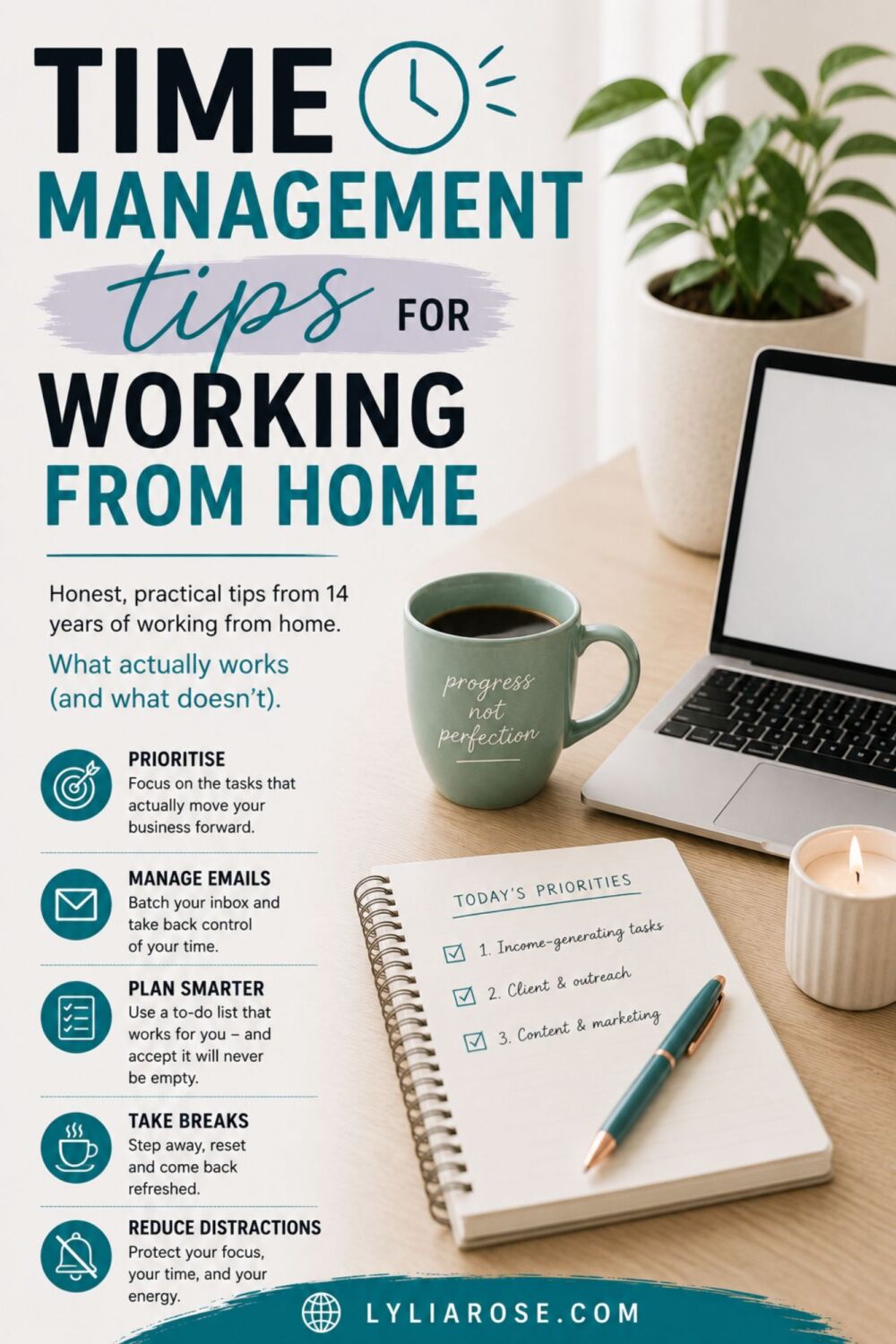
I've been working from home since 2012 and full time since 2017. Fourteen years in, you'd think I'd have time management completely figured out. I don't.
What I do have is a very clear picture of what works, what doesn't, and the gap between the advice you're supposed to follow and what actually happens when you're juggling 30 open tabs, 150 emails a day, and a never-ending to-do list that never actually ends.
Here are my honest time management tips for working from home - the real version, not the polished one.
Prioritise the tasks that actually make you money
This is the one piece of advice I wish someone had told me at the start, and it took me years to really internalise it.
When you work for yourself, not all tasks are equal. Some move the needle. Some feel productive but don't actually bring in income. The trap - especially when you love what you do - is spending hours tweaking your website theme, adjusting fonts, reorganising your sidebar, or going down a rabbit hole of improvements that nobody will notice. It feels like work. It is work. But it's not the work that pays you.
For me, the tasks that actually generate income are SEO and marketing on my own websites, cold outreach to new clients, following up with people who've already made contact, and checking in with existing clients I haven't heard from in a while. Those are the things I try to prioritise above everything else.
Everything else - the technical fixes, the design tweaks, the admin - gets done in between, not instead of. Growing your online business comes down to spending your time on the right things, not just spending a lot of time.
Create a to-do list - but accept it will never be empty
I have a never-ending to-do list. Genuinely never-ending. There are always tasks, technical issues, improvements, and ideas on it, and I will never get to the bottom of it.
That used to bother me. Now I see it differently - a full to-do list means the business is alive and always improving. The goal isn't an empty list; it's making sure the right things get done each day.
I use a combination of desktop sticky notes (the digital kind, always on my screen), scheduled email reminders, calendar alerts for time-sensitive things, and a general ongoing list for everything else. No single system works perfectly for everything, so I use whichever tool fits the task. The important thing is that nothing important lives only in my head.
If you're working from home and struggling with productivity, starting with a clear daily priority list - even just three things you absolutely must get done today - can give the day shape without the pressure of trying to clear everything.
Manage your emails before they manage you
I get around 150 emails a day. Left unchecked, that becomes unmanageable very quickly - so I go through them multiple times a day in batches, aiming to process around 20-30 at a time so they never pile up into something overwhelming.
The biggest time drain in my inbox isn't the volume though - it's the back and forth. Lots of negotiating, lots of going back and forth on details, and sometimes it leads to nothing. A conversation that takes 10 emails over three days might result in no work at all. That's just the reality of running a business, but it's worth being aware of so you don't let it eat your whole day.
My approach: work through emails a few times a day at set intervals rather than having them open constantly. Every notification pulls your attention away from whatever you were doing, and the constant switching has a real cost to your focus and output.
Accept that multitasking is unavoidable - but try to contain it
Every productivity article tells you not to multitask. I agree with the principle. I also have around 30 tabs open at any given time and switch between writing articles, graphic design, proofreading, invoicing, marketing, admin, and technical website fixes - often within the same hour.
The honest truth is that when you run your own business solo, some level of multitasking is unavoidable. You don't have a team to hand things off to. Everything lands with you.
What I try to do is contain it where possible - finish a piece of writing before switching to emails, complete a task before starting a new one, rather than having five things half-done simultaneously. I don't always manage it. But the tasks I give my full attention to are always better and done faster than the ones I've been dipping in and out of.
Be realistic about what you can achieve in a day
One of the biggest sources of stress when working from home is the gap between what you planned to do and what you actually did. The to-do list was too long, something urgent came in, a technical issue took two hours to fix, and now it's 9pm and you feel behind.
I've felt like this for years, and it wasn't until I started actually looking back at what I'd achieved - counting the emails sent, the tasks completed, the content published - that I realised I was getting far more done than it felt like. The feeling of never being on top of it isn't because you're not working hard enough. It's usually because the business keeps growing and the workload grows with it.
Be realistic with your daily list. Pick the priorities, do those first, and let the rest be a bonus. A good work-life balance when self-employed starts with not setting yourself up to feel like a failure every single day.
Take breaks - even if they're just coffee breaks
Proper breaks - stepping away from the screen, moving around, going outside - are good for your focus and your body. Working from home can take a toll on your body when you're sitting for hours, so getting up and moving matters.
In practice, my breaks are mostly coffee breaks with my husband. He works from home too, and just stepping out of my office to make a coffee and have a chat breaks the day up in a way that genuinely helps. It's not a long walk or a yoga session - it's ten minutes away from the screen. That counts.
I also eat lunch and dinner away from my desk most days. Those natural pauses in the day are worth protecting, even on busy days. Eating while answering emails means you get neither thing properly.
Reduce distractions where you can
The TV is the obvious one - what starts as background noise ends up pulling your full attention the moment something interesting comes on. I can't have it on when I'm working and focused. The only time it's on while I'm technically working is in the evenings when I'm in bed doing mundane admin tasks that don't need my full concentration. Anything that requires real focus gets done in silence.
My phone stays on silent during the day - but I have it set so calls from my children's schools, my husband and my children still come through. Everything else can wait. Most things that feel urgent in the moment genuinely aren't, and a notification that pulls you out of focused work costs more time than the few seconds it takes to glance at your phone. Every interruption means getting back into focus mode, and that takes longer than people realise.
I also regularly ignore the front door. We have a large parcel box and a wooden recycling box outside where couriers can leave deliveries, so there's no need for them to knock. If I start answering the door, checking my phone every time it pings, doing a bit of housework here and there - I can feel the difference in how much I get done. Each interruption breaks the flow and I have to work to get back into focused mode each time.
My office is kept minimal - a few decorative touches, but an uncluttered desk and a simple setup that's ready to work every day without things everywhere. A cluttered workspace is a distracted brain, and starting the day with a clear desk makes it easier to get straight into work.
Setting up a proper home office where everything has its place is one of the best investments you can make in your own productivity. And in summer, if the weather cooperates, working from your garden is a brilliant change of scene that can genuinely boost focus.
Final thoughts
Time management when working from home is a lifelong work in progress. After 14 years, I'm still refining my approach - and some days are better than others.
The things that have genuinely helped most: prioritising income-generating tasks first, processing emails in batches rather than constantly, being honest about what I can actually achieve in a day, and accepting that a never-ending to-do list isn't failure - it's just what running a growing business looks like.
For more on the realities of self-employment, my pros and cons of working from home article covers the full picture - the good, the challenging, and everything in between.