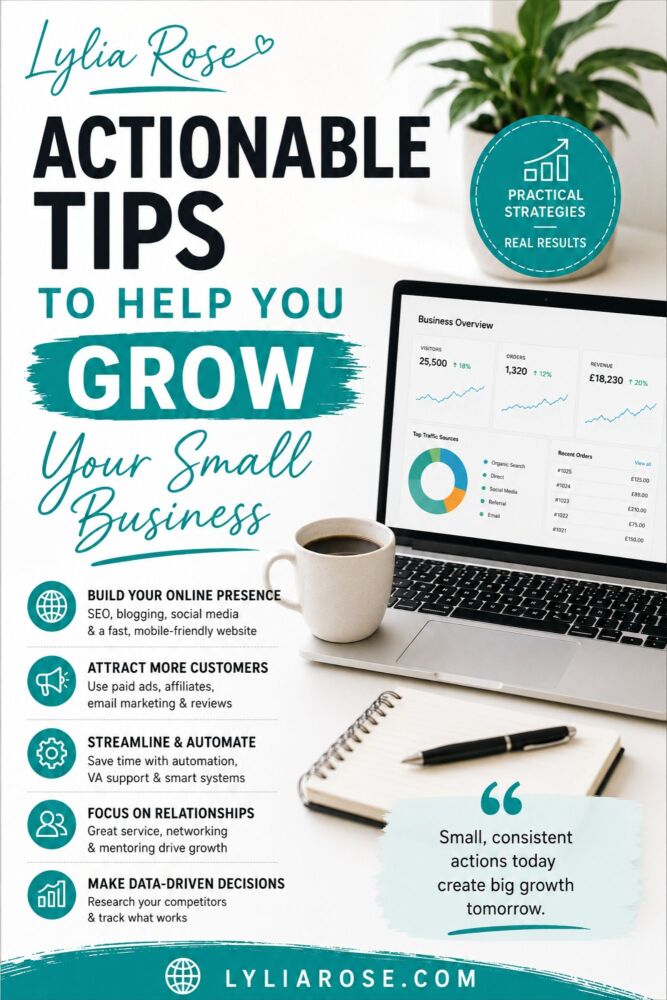
Actionable Tips To Help You Grow Your Small Business
Posted on
Want to grow your small business but not sure where to focus your efforts? You're not alone. Most small business owners have a solid idea and the drive to make it work - but knowing which actions will actually move the needle is another thing entirely.
I've been self-employed since 2012 and have grown multiple income streams from scratch. Here are the most effective, actionable tips I've found for growing a small business, covering everything from online presence to customer service.
How to grow your small business online
Having a strong online presence is no longer optional. If you're serious about starting and growing your own business, a website and active social media channels are the foundation everything else builds on.
The internet is a crowded place - there are now close to two billion websites competing for attention. So how do you stand out? It takes a combination of good SEO, quality content, and consistent effort, but it's absolutely achievable for a small business.
SEO
Search Engine Optimisation is one of the most important long-term investments you can make. Good SEO means your website appears when people search for what you offer - and unlike paid ads, the results compound over time.
To do it yourself, you'll need to understand keyword research, create high quality original content, build internal and external links, and ensure your site is technically sound. If you'd rather outsource it, working with a specialist SEO Agency can be well worth the investment, particularly if you're in a competitive niche.
Understanding SEO basics is something every small business owner should do, even if they eventually outsource the technical side.
Blog
A business blog is one of the best ways to improve your visibility online and build trust with potential customers. Regular, helpful content signals to Google that your site is active and authoritative, and gives visitors a reason to keep coming back.
If you're not sure where to start, thinking about what your first business blog post should cover is a good first step. Focus on answering the questions your customers are already asking.
Social media
Social media gives your business a voice and a direct line to potential customers who might never have found your website otherwise. It's free to use, works across all business types, and lets you interact in real time.
Use relevant hashtags, share your content consistently, and engage genuinely with others in your niche. You can also use video marketing on social media to dramatically increase reach - video content consistently outperforms static posts across most platforms.
Paid ads
Organic SEO takes time - typically three to four months before you start seeing meaningful results. And in some cases, 6 months to one year. In the meantime, paid advertising can fill the gap.
Google Ads lets you target people who are actively searching for what you offer, while Facebook and Instagram ads let you target by demographics and interests. Start small, test different approaches, and scale what works.
Affiliates
Setting up an affiliate scheme means others promote your business for you, and you only pay when a sale is made. Unlike pay-per-click advertising, it's genuinely performance-based - no results, no cost.
It's one of the more underused growth strategies for small businesses, but it can be powerful once you have a product or service worth promoting.
Responsive and fast website
More than half of all web traffic now comes from mobile devices. If your website isn't mobile-friendly, you're losing customers to competitors whose sites are easier to use on a phone.
Site speed matters too - it's a confirmed Google ranking factor, and a slow site puts visitors off. Test yours using Google's PageSpeed Insights tool and work through the recommendations. Improving your website branding alongside speed improvements gives visitors a much stronger first impression.
Make it easy to pay and book online
Nobody wants to phone up to make a booking or pay by cheque. Make it as easy as possible for customers to complete a purchase or reserve a slot online, at any time of day.
Offer multiple payment options - card, PayPal, Apple Pay - and if you run a service-based business, an online booking system removes friction and saves you time coordinating your diary.
Whichever route you choose, make sure your checkout is secure, clearly branded, and as frictionless as possible.
Use a business mentor or consultant
A mentor who has already built a successful business can save you years of trial and error. They can help you avoid common pitfalls, identify your next steps, and give you an honest outside perspective on what's working and what isn't.
For financial and business strategy advice, professional consultants are worth the cost. The clarity they provide can be worth far more than their fee. Learning the right approach to marketing your small business from someone who's done it is far more efficient than figuring it all out yourself.
Attend networking events
Networking is one of the most consistently underrated growth strategies for small businesses. Meeting people face to face builds trust faster than any digital interaction, and you never know which connection will lead to a new client, collaborator, or referral.
If networking feels daunting, remember everyone is there for the same reason. Be genuine, ask questions, and follow up afterwards. Even a short email the next day keeps the conversation going.
Automate tasks to save time
There are tasks in every business that can be automated - email sequences, social media scheduling, invoicing, reporting. Every hour you claw back from admin is an hour you can put into growing the business.
Accounting software like Quickbooks can automate a lot of the financial admin that eats into your week. Social media scheduling tools mean you can batch-create content and have it go out automatically. The pros and cons of working from home are worth thinking through too when it comes to structuring your day - good time management and automation go hand in hand.
Hire a virtual assistant
If you're a solopreneur and not ready to hire permanent staff, a virtual assistant is a brilliant middle ground. They're self-employed, you hire them as and when you need them, and they can take over the tasks that eat your time without adding the cost and commitment of an employee.
Phone management, email filtering, bookkeeping, social media scheduling - all of these can be handled by a good VA, freeing you up to focus on the work that actually grows the business. Good time management as a business owner becomes much easier when you're only doing the tasks that genuinely need you.
Build an email list
An email list is one of the most valuable assets a small business can build. Unlike social media followers, you own your list - no algorithm can take it away from you.
Use sign-up forms on your website to capture emails, and give people a good reason to subscribe. Once you have a list, you can reach out directly to existing customers about new products or offers, or use it to source new work if you offer a service.
Be consistent with branding
Your brand is how customers recognise and remember you. Consistency across your website, social media, emails, and marketing materials makes you look professional and builds trust over time.
Make sure your message is clear and your visual identity - colours, fonts, logo - is applied consistently everywhere. If you have staff or contractors working with you, make sure they understand and represent the brand just as you would.
Ask for reviews and referrals
Reviews are one of the most powerful trust signals you have. A handful of genuine, detailed reviews from happy customers can do more for your business than any ad campaign.
Ask your best customers directly - most people are happy to leave a review if asked at the right moment. Encourage word of mouth too, and consider setting up a formal refer a friend scheme to reward customers who send new business your way.
Provide outstanding customer service
Great customer service is what turns a one-time buyer into a loyal customer who recommends you to everyone they know. It's also what separates businesses that grow steadily from those that plateau.
Go beyond what's expected. Respond quickly, follow up after a purchase, and make it easy for customers to reach you. A loyalty programme or regular email newsletter keeps existing customers engaged and shows appreciation for their support.
Research your competitors
Understanding what your competitors are doing well - and where they fall short - gives you a significant advantage. Look at their websites, their social media, their reviews. What are customers saying? What gaps exist that you could fill?
Tools like Ahrefs let you see what keywords competitors rank for and where their traffic comes from, which can reveal opportunities you hadn't considered.
Final word
Growing a small business takes consistent effort across a lot of different areas - there's no single magic tactic. But the businesses that grow steadily are the ones that show up consistently, look after their customers, and keep improving.
Start with the areas where you have the biggest gaps - whether that's SEO, social media, or customer service - and build from there.