What Are the Hidden Costs Authors Should Be Aware of When Publishing on Amazon?
Posted on
The short answer to "how much does Amazon book publishing cost?" is: nothing upfront. Kindle Direct Publishing (KDP) is completely free to use - you upload your book, set your price, and Amazon handles the rest. There are no registration fees, no submission costs, and no gatekeepers.
But "free to publish" and "free to produce a good book" are very different things. If you want to self-publish something that actually sells, there are real costs involved - some optional, some effectively essential. Here's a clear breakdown of what Amazon self-publishing actually costs, so you can budget properly before you start.
Is Amazon KDP really free?
Yes - the platform itself costs nothing. You don't pay to list your ebook or paperback on Amazon. Instead, Amazon takes a percentage of each sale as its fee:
- Ebooks: You keep 70% royalties on books priced between £1.99 and £9.99, or 35% outside that range
- Paperbacks: Amazon deducts a printing cost per copy sold (more on this below) and you keep the remainder
So you only pay when you sell, and you never pay upfront to the platform. That's genuinely good news for first-time authors.
The costs come in when you consider everything else that goes into making your book competitive.
Amazon self-publishing costs: what you might spend
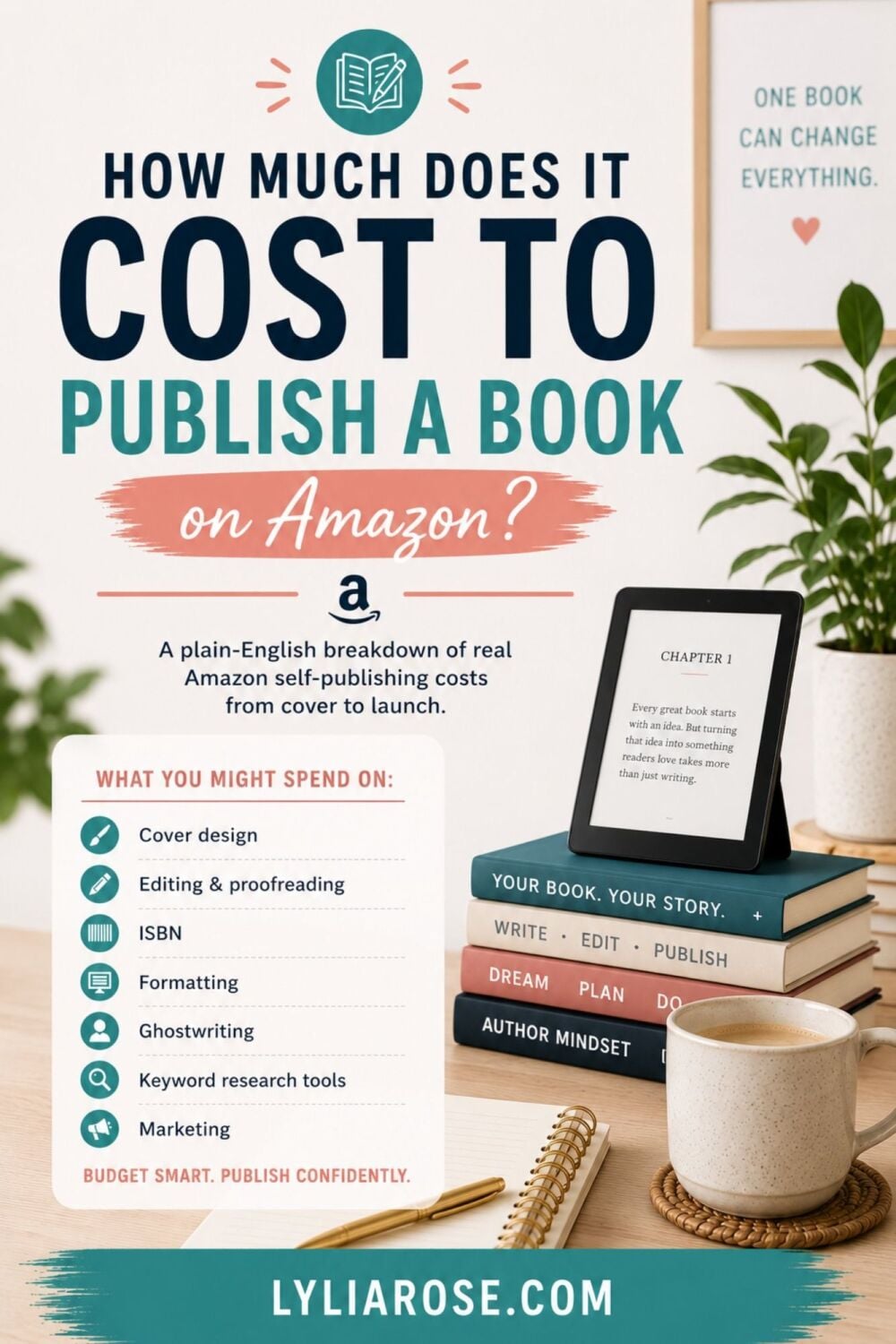
Cover design
Your cover is your most important marketing asset. Readers make split-second decisions based on it, and a homemade cover signals amateur immediately - regardless of how good the writing is.
A professional cover designer typically charges between £300 and £1,000 depending on complexity and experience. If that's outside your budget, pre-made covers are a cheaper option - you can find them from around £50 to £150 on sites like Premade Book Covers or 99designs. Canva can work for very simple non-fiction covers if you have an eye for design, but be honest with yourself about the result.
If you do nothing else on this list, invest in a good cover.
Editing and proofreading
Even excellent writers benefit from an editor. An objective professional eye catches things you can't see in your own work - plot holes, inconsistencies, unclear passages, and errors that slip through no matter how many times you reread.
There are three main types of editing:
Developmental editing focuses on the big picture - structure, pacing, plot, character. It's the most expensive type, typically around £15 per page or £0.90 per word.
Copy editing refines sentence structure, word choice, and flow. Expect to pay around £2.50 to £5 per page.
Proofreading is the final pass for spelling, grammar and formatting errors. This typically costs £1.50 to £3.50 per page.
For a 60,000-word novel, even just a copy edit and proofread could run to £500 to £1,000. It's not cheap, but unprofessional editing is one of the most common reasons self-published books get poor reviews.
ISBN
Amazon provides a free ISBN if you publish through KDP - but this ties your book exclusively to Amazon's platform. If you want to sell elsewhere, you'll need your own ISBN.
In the UK, ISBNs are issued by Nielsen. A single ISBN costs around £89; a block of 10 costs around £164 (better value if you plan to publish more than one book or edition).
If you're only ever planning to sell on Amazon, the free KDP ISBN is fine.
Formatting
Your manuscript needs to be formatted correctly for both ebook and print. Ebook formatting is relatively straightforward - there are free tools like Kindle Create and Calibre that do a decent job. Print formatting is more complex, particularly if your book includes images, charts, or tables.
If you want to do it yourself, Draft2Digital offers free formatting tools. Hiring a professional formatter typically costs between £100 and £300.
Ghostwriting
If you want to publish a book but don't want to (or can't) write it yourself, ghostwriters are an option. Platforms like Upwork connect you with writers at various price points. For a 30,000-word book, expect to pay roughly £800 to £1,600 depending on the writer's experience and your subject matter. Specialist niches - medical, legal, technical - command higher rates.
This is one of the less essential costs for most authors, but worth knowing about if you're considering it.
Keyword and niche research tools
If you want your book to be discoverable on Amazon, keywords matter enormously. They determine how Amazon categorises your book and when it appears in search results.
You can research manually using Amazon's own search bar, but dedicated tools like Publisher Rocket (around $97 one-off) or K-lytics make the process faster and more accurate. This isn't essential, but it does give you a competitive edge - particularly in crowded niches.
Marketing
This is where costs can vary most dramatically. You can market a book for almost nothing using social media, email lists, and free promotional tools - or you can spend thousands on paid advertising.
Amazon's own advertising platform (Amazon Ads) lets you start with as little as $2 to $5 per day. Lock-screen ads for Kindle devices require a minimum budget of $100. Facebook and BookBub ads are other options. Most authors find that some level of paid advertising is necessary to gain initial traction, particularly for fiction.
A realistic initial marketing budget for a debut self-published book might be £200 to £500 if you're being cautious.
Paperback printing costs
If you're selling physical copies, Amazon deducts a printing cost per copy from your royalties. You don't pay upfront - it comes out of each sale. The printing cost depends on page count and ink type:
- In the US: minimum approximately $0.85 per copy (black and white, standard pages)
- In the UK: minimum approximately £0.70 per copy
Colour pages cost significantly more. For a 300-page novel in black and white, you'd typically pay around $2.50 to $3.00 in printing costs per copy in the US.
What does Amazon self-publishing cost in total?
Here's a realistic cost range depending on how much you invest:
| Approach | Estimated cost |
|---|---|
| DIY everything (free tools, basic cover) | £0 to £200 |
| Mid-range (professional cover, proofreading) | £500 to £1,500 |
| Full professional (cover, editing, formatting, marketing) | £2,000 to £5,000+ |
Most authors fall somewhere in the middle. The bare minimum viable approach is a professional cover and at least a proofread - everything else can be scaled based on budget and ambition.
Is Amazon self-publishing worth the cost?
That depends entirely on your goals. If you're publishing a business book to establish credibility, or a niche non-fiction guide in a low-competition space, the ROI can be very strong. Fiction is more competitive and harder to profit from without meaningful marketing investment.
The cost of Amazon self-publishing is genuinely low compared to traditional publishing routes - and unlike traditional publishing, you keep control and a far higher percentage of each sale. But treating it as a zero-cost enterprise and cutting corners on quality is usually a false economy.
Before you go...
For more on making money from creative work and side hustles, take a look at how to make extra income while working full time, how to successfully sell handmade items locally and online, and real ways to make money from home for free.