How To Cope With A Growing Business
Posted on
Watching your business grow is one of the best feelings. All those hours you've put in, the uncertainty in the early days, the moments where you wondered if it was actually going anywhere - and then it starts to work. Customers come back. Word spreads. Demand increases.
But growth can also be genuinely stressful, especially if it happens faster than you expected. Suddenly the systems that worked fine when things were quiet aren't keeping up. You're stretched. Things are slipping. And the excitement starts to come with a side of overwhelm.
I've been running my own online business full-time for years and I know that feeling well. Here are some practical ways to manage business growth without losing your mind in the process.
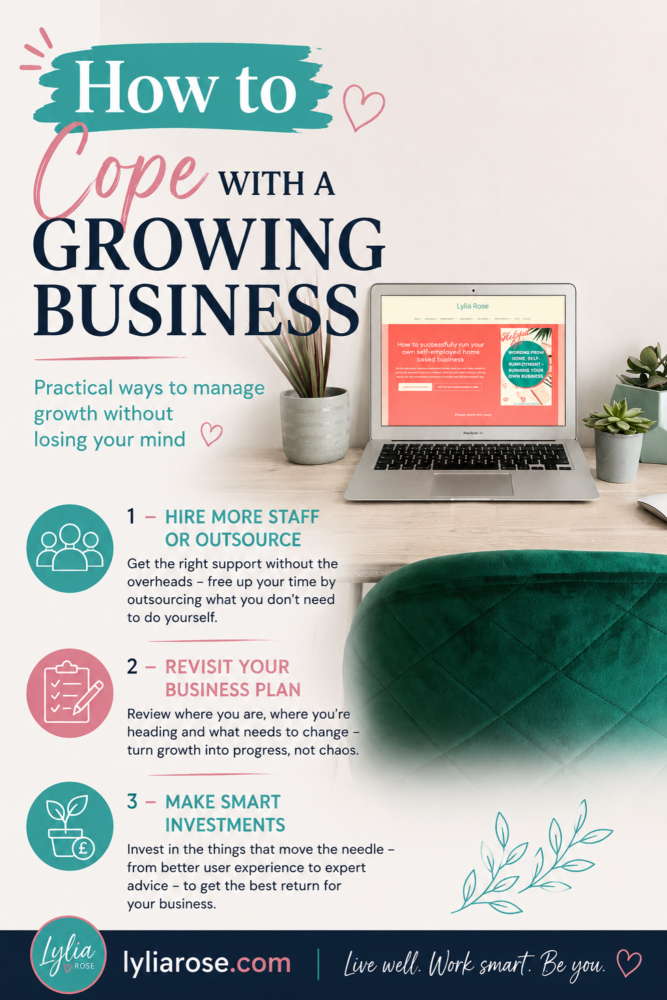
Hire more staff or outsource
The most obvious response to growth is getting more hands on deck - but it's worth thinking carefully about the right way to do that for your situation.
Hiring staff is a big commitment. Salaries, employer responsibilities, management time - it's not always the right first step, especially if the increased workload is in a specific area or you're not sure yet how sustained the growth will be. Outsourcing to freelancers or specialist agencies is often a more flexible starting point. You can scale up or back depending on what's needed, and you're not locked into fixed costs.
There are plenty of services you can outsource as a small business - marketing, admin, customer service, bookkeeping, social media. If there's a task that's eating your time but doesn't need to be done by you specifically, it's worth pricing up what it would cost to hand it off. Often the time you'd free up is worth more than the fee.

Revisit your business plan
Most people write a business plan at the start and then barely look at it again. But if your business is growing, your original plan is probably already out of date - and that matters, because growth without direction tends to create chaos rather than progress.
Set aside some time to review where you are versus where you expected to be, and then map out the next phase. What does the business need to look like in 12 months to handle this level of demand? What needs to change - in terms of processes, tools, capacity, or focus? Getting this down on paper makes it much easier to make decisions as things continue to develop, rather than just reacting to whatever's in front of you that day.
It's also a good time to review your marketing strategy - what's been driving the growth, and how do you maintain and build on it?
Make smart investments
When money starts coming in more consistently, the temptation can be to either hoard it out of caution or spend it quickly. Neither extreme tends to serve a growing business well.
Think carefully about where investment will actually move the needle. One area that often gets overlooked is user experience - how easy it is for customers to interact with your business online. UX design services can make a significant difference here, helping you develop products and digital touchpoints that are genuinely easy to use and that address what your customers actually need. Good UX reduces friction, improves conversion, and keeps people coming back - which makes it one of the smarter places to put money when you're scaling.
A business financial advisor is also worth considering at this stage if you're not already working with one. An accountant can help with tax efficiency, but an advisor can help you think strategically about where your profit should go to get the best return.
Think about what else you can offer
Growth often signals that your customers trust you - and that's a real opportunity. Once you have an established base of people who like what you do, it becomes much easier to introduce something new, whether that's an additional product, a service, a premium tier, or something adjacent to what you already offer.
The key is not to overextend. Adding something new takes time and resource, and if it pulls your focus away from what's already working, it can actually slow you down rather than accelerate things. Test ideas on a small scale first, and keep your customers engaged throughout - their feedback will tell you quickly whether something is worth pursuing further.
Don't forget about yourself
This one doesn't get talked about enough. When a business grows quickly, it's usually the owner who absorbs the pressure - working longer hours, taking on more, pushing through. For a while that works. But it's not sustainable, and burnout is a very real risk when you're trying to manage everything at once.
Building in time to step back, whether that's protected time off, regular check-ins with how you're actually feeling, or just a clear end to the working day, matters just as much as any of the practical steps above. A good work-life balance isn't a luxury when you're self-employed - it's what keeps the business running long-term.
Growth is a good problem to have. But it's still a problem that needs managing, and the sooner you put the right things in place, the more you'll actually enjoy it.