What Are the Disadvantages of a Home Based Business?
Posted on
Running a home-based business sounds like the dream, and in many ways it is. But after more than a decade of doing it full-time, I want to be honest about the downsides too. One of the challenges of running a home-based business is that the difficulties are less visible than the benefits - people see the flexibility and the autonomy, but not the isolation, the blurred boundaries or the relentless self-discipline it requires. There are real challenges that don't get talked about enough, and if you're considering going self-employed from home, it's worth knowing what you're actually signing up for.
Someone once said to me "you're practically retired aren't you?" I work anywhere from 30 to 70 hours a week, usually somewhere in the middle. I just do it from home. If anything, I work more now than I ever did in employment - and even then I regularly did overtime and worked six days a week.
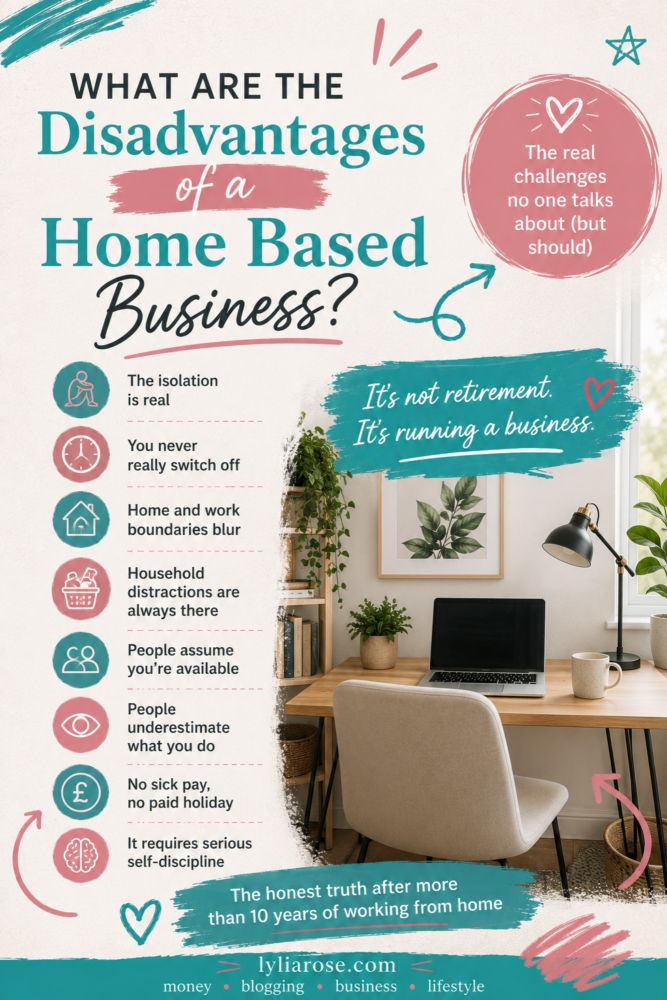
The isolation is real
This is the one that's crept up on me the most over the years. I genuinely enjoy working alone - I'm an introvert and I find my own company easy - but that doesn't mean isolation doesn't have a cost.
I've been self-employed throughout my thirties and now into my forties. I have no colleagues, no work events, no office friendships that develop naturally over time. Most people meet a significant number of new people through work. I don't have that. The social side of a traditional work environment - the banter, the shared experiences, the friendships that form just from being in the same place every day - simply doesn't exist when you work alone from home.
I've made peace with this, and I have my husband - who is also my best friend - my kids and a couple of friends. But it's worth being honest: if you go self-employed from home in your twenties or thirties and stay that way, you will probably have fewer friendships than your peers who work in offices. That's not a reason not to do it, but it is something to be aware of and to actively work against. My guide on how to successfully work from home covers some practical ways to stay connected and keep the isolation manageable.
You never really switch off
When your office is in your home, work is always available. There's no commute to mark the end of the day, no physical separation between where you work and where you live. The laptop is always there. The emails are always there. The to-do list is always there.
I've worked hard to build boundaries around this - I have my own office now, which helps enormously - but in the early years it was genuinely difficult to stop. I've worked evenings, weekends, school holidays and on every single holiday we've ever taken. I bring my laptop wherever I go. I've never fully switched off, and that wears on you over time.
If you're going to make a home-based business work long term, you have to be deliberate about building in rest. It won't happen by default. I've written about how to switch off when self-employed because it's something I've had to actively work at.
The home and work boundaries blur
Related to the above, but slightly different: when you work from home, your home is never just home. The room you sit in to relax is also the room you were stressed in during a difficult client call. The kitchen where you make dinner is the kitchen you walked through during your lunch break. The two spaces - work and home - become one, and that blurring takes something away from both.
I have a dedicated home office now which helps create some physical separation, but for years I worked from a shared space and the lack of separation was genuinely draining. If you can, having a dedicated room - even a small one - that is only for work makes a real difference to both your productivity and your ability to mentally clock off. I've shared exactly how I've set mine up in my guide to creating a healthy home office.
Household distractions are always there
The washing pile. The dishes. The garden. The parcel that needs posting. The thing you've been meaning to fix for weeks. When you work from home, every domestic task is visible to you all day and it requires real discipline not to let them eat into your working hours.
Add children into the mix and the distraction level multiplies significantly. I have two kids and for years I worked around school runs, sick days, school holidays and the constant background noise of family life. It's manageable, but it requires more discipline than most people expect - and honestly, it can be really stressful when you just need some peace and quiet to work and the house won't cooperate.
People assume you're available
This one frustrated me enormously in the early years. Friends and family would suggest meeting up on a Tuesday afternoon, or pop round unexpectedly in the middle of the day, or ask if I could help with something at short notice - because I "work from home" and therefore must be flexible, or even free.
I'm not free on a Tuesday afternoon. I'm working. Just not in an office.
This has got better over time as people have understood what I actually do. But it's a common experience for home-based business owners, especially in the early years, and it can be genuinely hard to manage without damaging relationships.
People underestimate what you do
Alongside the assumption of availability comes the assumption that working from home isn't really working. The person who implied I was "practically retired" isn't an isolated case. There's a perception that home-based work is somehow less serious, less demanding or less valid than going to an office.
For the record: I work full-time, often more than full-time, from my home office. I run three websites, manage client relationships and have been the primary earner in my household since 2019.
It's not retirement. It's not easy. In fact it's nowhere near retirement - there are no days off, no cushion of money to live off, no pension being paid in by an employer. We are nowhere near retirement stage. We work full time like most people, living month to month, paying bills and wondering if we're going to make enough next month, or whether we can actually afford to save anything towards retirement in the future.
It requires just as much - if not more - self-discipline than office work, because you have to create all the structure yourself with no external accountability.
No sick pay, no paid holiday
These are the practical financial realities of self-employment. If you're ill, you don't get paid. If you take a holiday, you don't get paid unless you work during it (which I always do, every working day). I haven't had a proper holiday without working in over a decade. There are no employee benefits, no employer pension contributions, no paid parental leave.
This is manageable if you plan for it - I've covered the financial aspects in more detail in my guide to going self-employed and how to be financially secure - but it's a significant adjustment from employment and one that catches people out.
It requires serious self-discipline
Without a boss, fixed hours or colleagues around you, everything depends on your own ability to motivate yourself and stay on task. On the difficult days - and there are difficult days - there's no external structure to carry you through. You have to provide that yourself.
Some people thrive with that level of autonomy. Others find it genuinely difficult. It's worth being honest with yourself about which you are before going all in.
The positives are real too
I want to be clear: I wouldn't swap running my own home-based business for anything. The flexibility, the autonomy, the ability to build something that's genuinely mine - these things matter enormously to me and make the challenges worth it. If you want the other side of this picture, I've also written about the pros and cons of working from home which covers both sides honestly.
But going in with realistic expectations makes everything easier. The people who struggle most with self-employment are often the ones who expected it to be easier than office work. It's different, and in some ways it's harder. Knowing that in advance gives you a better chance of making it work long term.