The Essentials For Working From Home
Posted on
Working from home is something I've been doing since 2012 - over 14 years now - and full time since 2017. Honestly, I wouldn't swap it. No commute, no office politics, total flexibility - it suits me completely. But let's not pretend it's without its challenges.
I work anywhere from 30 to 60 hours a week from home. I have my own dedicated office - the smallest bedroom converted into a proper workspace, with a standing desk and a separate sitting desk. My husband works from home most of the time too, though he has a garden office, so we're not constantly on top of each other.
And yet, despite having the ideal setup on paper, I still struggle with some of the same things I did at the start. The laundry is always there. The doorbell goes. The kids come home from school. And the work? It's always there too - which means switching off is genuinely hard.
If you're working from home or thinking about making the move, here's my honest take on what actually helps.
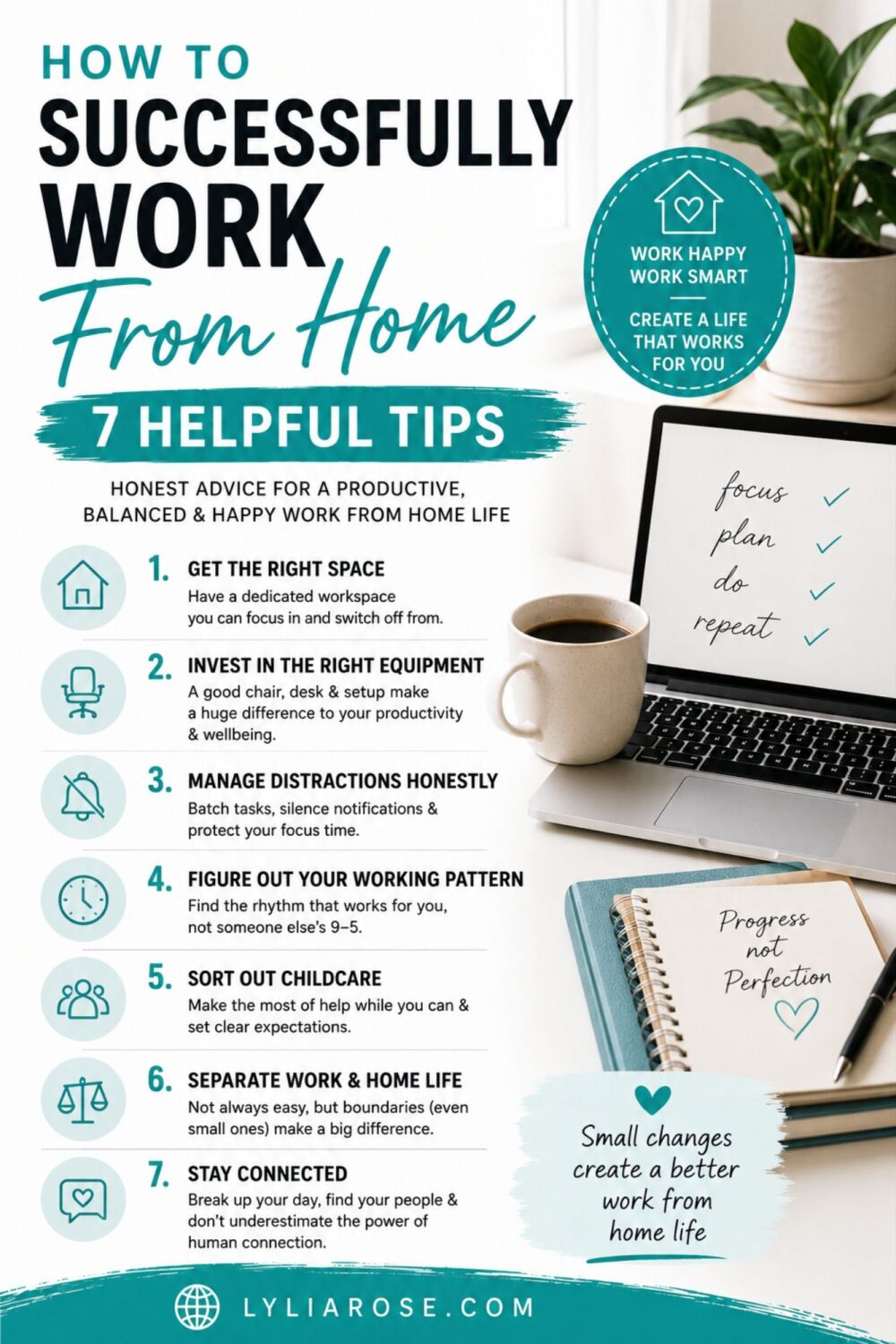
1. Get the right space
The single biggest thing you can do to make working from home work is to have a dedicated space for it. Not the kitchen table. Not the sofa. A room with a door that you can close.
My office is the smallest bedroom in the house. It's not glamorous but it's mine - set up purely for work, with everything I need within reach. Having that separation between work space and living space makes a real psychological difference, even if you can't always stick to it.
If you don't have a spare room, a garden office like my husband's is a brilliant solution. It creates that commute-free but physically separate workspace that makes it much easier to leave work behind at the end of the day. For ideas on creating a home office that works for you, it's worth thinking carefully about layout and lighting before you commit to a setup.
Make it a space you actually want to be in. Just because it's functional doesn't mean it has to be dull.
2. Invest in the right equipment
A good chair and desk make more difference than most people expect. If you're going to spend 30, 40, 50 hours a week at a desk, it's worth getting it right. I have both a standing desk and a sitting desk - switching between the two throughout the day makes a big difference to how my body feels by evening.
Think about what you actually need to do your work well: the right monitor setup, decent lighting, a comfortable chair that supports your posture. Getting the best work from home chair for your setup is one of those investments that pays off quickly.
Stock up on the basics too - stationery, printer supplies, whatever you regularly need - so you're not constantly having to stop work mid-task to sort something out.
3. Manage distractions honestly
Here's the thing nobody really talks about: working from home doesn't automatically make you more focused. In some ways it makes it harder.
The laundry pile is visible from my office door. The dishwasher needs emptying. There's a parcel to collect. A quick tidy-up turns into an hour of housework. Sound familiar?
The distractions are constant and they're domestic, which means they feel productive even when they're pulling you away from actual work. My honest advice is to accept that you'll never eliminate this entirely, but try to contain it. Batch the household tasks - do them before work starts or on a proper break, not scattered throughout the day. Turn off non-work notifications on your phone during your core working hours.
Understanding how to avoid distractions when working from home is an ongoing process rather than something you solve once - your approach will probably shift depending on what life looks like at any given time.
4. Figure out your actual working pattern
Every piece of advice about working from home tells you to set strict hours, start at 9am, finish at 5pm. In theory, great. In practice, most self-employed people work nothing like this.
I typically start between 11am and midday. I work through the afternoon, stop to cook dinner, eat with the family, and then often work again in the evenings - on the sofa, or in bed, on my laptop. It's not the textbook approach, but it works for my life and my brain.
The important thing isn't whether your hours look conventional. It's whether you're getting the work done, meeting your deadlines, and not burning yourself out. For many people, making money working from home requires a flexible approach rather than a rigid one.
That said, some structure genuinely helps. Even just deciding when you'll start each day and having a rough plan of what you want to achieve gives the day shape.
5. Sort out childcare for focused work time - while you still can
When my kids were younger, holiday clubs were a lifesaver. A few hours of structured activity, some peace to work, everyone happy. But kids grow out of those, and after school clubs don't work for every child or every location. Ours didn't get on with the one near us, so the deal we landed on was that they come home, do their homework and reading quietly for a couple of hours, and leave me to work.
In theory, brilliant. In practice - they're 14 and 11, and I still regularly find myself telling them to leave me alone because I'm working. Even at those ages, the interruptions are constant. They're hungry, they want to tell me something, they've had a disagreement, the WiFi's dropped. It never fully stops.
My honest advice is to make the most of proper childcare arrangements while they're available to you - holiday clubs, childminders, playgroups - because once kids are past that age, you're largely negotiating. And I say that knowing not everyone has family nearby to help. We don't. We live nowhere near friends or family, so it's always been us or paid childcare - no backup, no "can you have them for a couple of hours" option. If that's your situation too, you'll know exactly what I mean. Surviving the school holidays when you work from home takes more planning than most people expect, and it doesn't necessarily get easier as they get older - it just gets different. In theory, older kids should need less supervision. In practice, the interruptions just change form.
6. Try to separate work and home life - even if you can't always manage it
This one I'm not going to pretend I've perfected. I work in the evenings. I check emails in bed. The work is always there.
Part of it is that I enjoy what I do - but honestly, the bigger driver is the nature of self-employed income. My earnings vary day to day. My work isn't scheduled weeks in advance; it's one-offs, opportunities that come in, things that need actioning now. Every hour I'm not working is potentially money I'm not making. Time genuinely is money, and when your income isn't guaranteed, it's incredibly hard to close the laptop and call it a day.
There's also the constant pull to improve - better SEO, better content, better processes. A business like mine always has something that could be done better, and when it's your own business there's nobody to hand the responsibility to at 5pm.
I know the advice. Dedicated hours, a hard stop, leave work in the office. I believe in it. I just don't always manage it. And I suspect most self-employed people would say the same if they were being honest.
What does help, even a little: a dedicated workspace you can physically leave, small end-of-day rituals that signal you're done for now, and accepting that some days you'll nail the balance and some days you won't. Getting the work-home balance right when you're self-employed is an ongoing negotiation, not a problem you solve once.
7. Stay connected with people - even when it's hard
I'll be honest: this is the section I find hardest to write, because it's the one I struggle with most.
I'm an introvert with social anxiety. Working by myself isn't something I tolerate - I genuinely thrive on it. I can zone everything out, lose hours in my work, and feel completely in my element. My business is my focus and my hyperfocus. I'm obsessed with it in the best possible way, and the solitude that comes with working from home suits me perfectly.
But. I do feel lonely sometimes. Isolated. And I know I probably need to get more involved with something locally - a group, a community, something. The problem is committing to anything when my work can suddenly pick up and demand my full attention. And honestly, the anxiety about putting myself out there is real too.
What does keep me connected during the day, in a small but genuinely helpful way, is a couple of coffee breaks with my husband. He works from home most of the time too - in his garden office - and just stepping away from my desk to make a coffee and have a chat with him breaks the day up in a way that matters. It's a small thing, but it stops the day feeling entirely solitary.
So I don't have a neat answer here beyond that. Online communities for your niche or industry can help fill some of the gap with much lower stakes - no showing up somewhere new, no small talk with strangers. Fellow bloggers and self-employed people online have been more of a support network for me than most local things have.
If you work from home and find it lonely, you're not alone in that. And if you're an introvert who simultaneously loves working alone but misses human connection - that contradiction is completely normal. Improving productivity when working from home is one thing, but looking after your mental wellbeing alongside it matters just as much.
Final thoughts
Working from home is genuinely brilliant - but it's not without its challenges, and anyone who tells you otherwise is either very disciplined or not being completely honest. The laundry will always be there. You'll blur the lines sometimes. You'll work evenings when you said you wouldn't.
The goal isn't perfection. It's finding a setup and rhythm that works for your life, your work, and your brain - and being willing to adjust it as things change.